

Summary of the previous article
I probably went too far in my previous article… It’s true: it’s not because I have too few family and friends and that prevents me from launching my crowdfunding project that it should reflect on you. Of course, it’s a significant problem but even so, you are not particularly responsible for it. Afterwards, I maintain what I said: I have a real aversion to social networks and I have a lot, but really a lot of trouble finding anything positive in social networks.
Maybe I simply wanted to stay away from them until now to have a certain form of peace, to not feel the pressure from the public to release something soon when I have just finished a new project that required a lot of work? Maybe also that I believe that there is a time to create and a time to highlight what we have created and that in fact I have never gone beyond the first stage? It would be plausible and credible.
Now, the problem is mainly that I will have to find a way to form a community and it’s not easy… As I said before, TuneCore seems to be a good option but… Even if they accept productions using AI, the conditions remain difficult to ensure the possibility of an edition, especially with the RIAA lawsuit that is filing a complaint against SUNO and UDIO at the same time as I am launching my project and that, somewhere, is unbearable!
Well, after somewhere I can always claim the fact of starting as often as possible from a usable demo to reconstruct a song but the result depends strongly on what was recorded initially and on the versions of the “PrEvIoUsLy UnReLeAsEd” 1 to 3 the recording is done with the means at hand while with the 4th iteration we finally have usable sound which allows to bring back many more compositions made on the basis of a demo…
But precisely, we are going to talk about the mechanics in this article!
13. Building with SUNO – Part 1
Well, in this article we’re going to talk a little “technical”. Don’t worry, I’m not going to confuse you with a bunch of unreadable technical terms, but simply explain how I work with SUNO and the problems I can encounter… You’ll see, you’ll like it! In any case, you’ll quickly understand why it quickly becomes complicated in some cases to give a contribution other than the lyrics and the structure to a song. Indeed, the song does not have to be 100% generated by AI to go to TuneCore. For me, 100% generated corresponds to an automatic generation via a prompt in SUNO. Here indeed there is no contribution from the musician since apart from the prompt which represents max 5% of input, the structure and the lyrics are not even written by the author and so there is no pilot in the plane… The ideal is to have your own lyrics and to know how to structure your songs: For me that represents 25% of the initial work. I grant 25% more for the assembly, the cutting and the listening and selection of the different parts of the same song (the added value also goes through the “creative touch” of the artist, otherwise it’s not fun) and the best of the best is when you can bring back bits of the original demo in it… Let’s see it in detail:
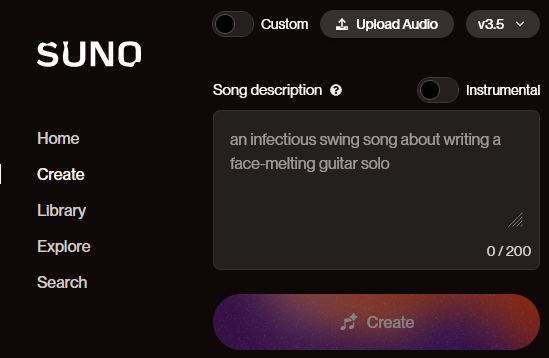
The famous SUNO “prompt” for basic jerks
First of all, you should know that by default, it is out of the question that I make a prompt to create a song. No, I will really bother typing lyrics and the structure of the song with it. Besides, there is a non-exhaustive but still quite complete site that can help you write more than just prompts: it is the Holy Grail of SUNO configuration and it is in fact a fairly short and succinct WIKI but for a starting base it is just great and it is available here! Afterwards, you have every right to ask the AI to do something else or even anything and even test things… Sometimes it will work, sometimes the thing in question will screw up so much that you will want to throw the track in the trash right away… When the singer starts singing “with an 80 bpm tempo” and “choir of female voices” when they were just indications of what you wanted to generate at that moment, well of course it doesn’t work at all… Sometimes, SUNO still has a little trouble doing what you ask of it but we’ll talk about that a little later;
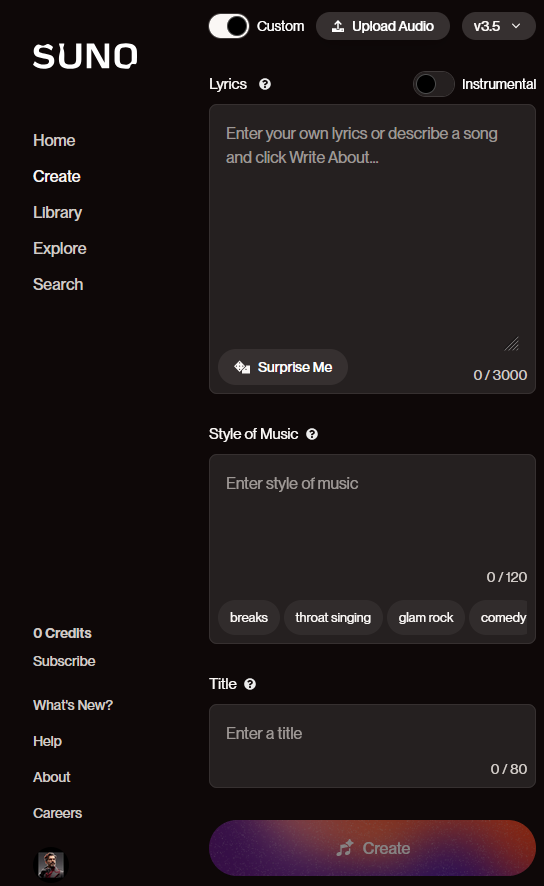
And the “Custom” mode for those who want to make a big deal out of it!
As for me, I never do “prompt” and I always go through “Custom” mode without clicking on “Surprise Me” because it is automatic generation of lyrics. Concretely, what I want as a musician is to bring a “touch”, a feeling that you find through the sound and the lyrics, a real identity. Almost all musicians will tell you that what is generated by AI has no soul… And this is true for the “prompt” mode but much less in the “custom” mode where the lyrics and the style of music will largely influence the final rendering. Indeed, the AI will have to analyze the lyrics to pronounce them and find the most appropriate voice… It is therefore clear that the AI also lets itself be influenced by the inputs that we give it and the higher the quality, the more what comes out looks less and less like an undrinkable soup re re re re re re re re heated! And if we also add our own original soundtrack, then there… No more excuses to say that we can’t do something different and decent with AI.
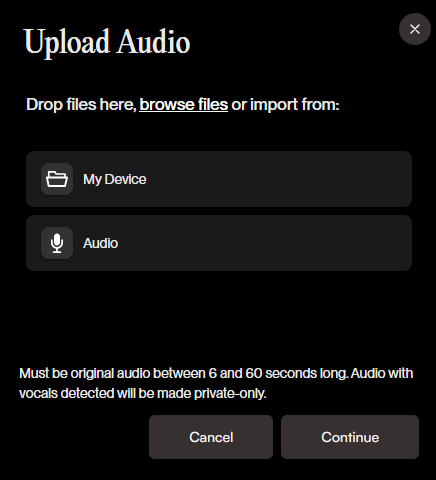
Whenever possible, I go through “Upload Audio” to start a song with an actual sample.
But before I go and tease the AI and tell it to generate a track that destroys everything that exists and for the AI to make me something unusable that eats itself and vomits itself continuously, I have some preparatory work to do… Well yes, because it’s all well and good to tell it “go ahead, eat the 6 to 60 second piece that I’m going to give you as the basis of the song” but if we haven’t prepared the piece and we throw an 8 minute track at it, it’s just going to yell and say “hey! it doesn’t say the Post Office there” and it’s going to spit it back in your face… No more than 60 seconds or even 59 to be sure that it’ll work… And then how do we do it? Well first of all, we’re going to equip ourselves with software that costs nothing but is so effective that we’d almost want to pay for it because it’s going to provide us with immeasurable services. I ask you to give a standing ovation for “AUDACITY”, the software that will simplify our lives! But just before using it, I will show you something that we usually never show:
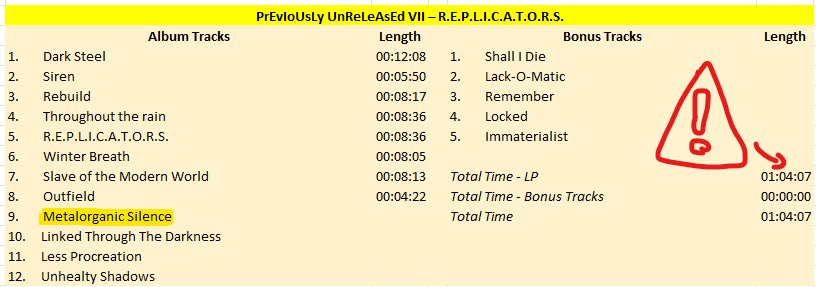
But… it looks like a plan, a real one!!!
Because yes, I don’t work blindly. Before starting all this, I took the time to make a Microsoft Excel file in which I carefully recorded my different albums according to a structure that was almost identical from one album to another… And you know what? It worked well until I got to PrEvIoUsLy UnReLeAsEd VII – R.E.P.L.I.C.A.T.O.R.S. and that’s when the drama started. Let me explain: until we got to this album, I composed songs that were between 4 and 6 minutes long, max, with some exceptions. The idea was to never exceed 1 hour per album and to put 12 songs per album. However, the songs on R.E.P.L.I.C.A.T.O.R.S. have this particularity in that they are fewer in number and much longer. I have a rational explanation to provide but I’ll keep it for the chronicles of the making of the different albums that I’ll talk about much later… First we’ll talk about the making and so my next track is “Metalorganic Silence”. It’s going to be something!
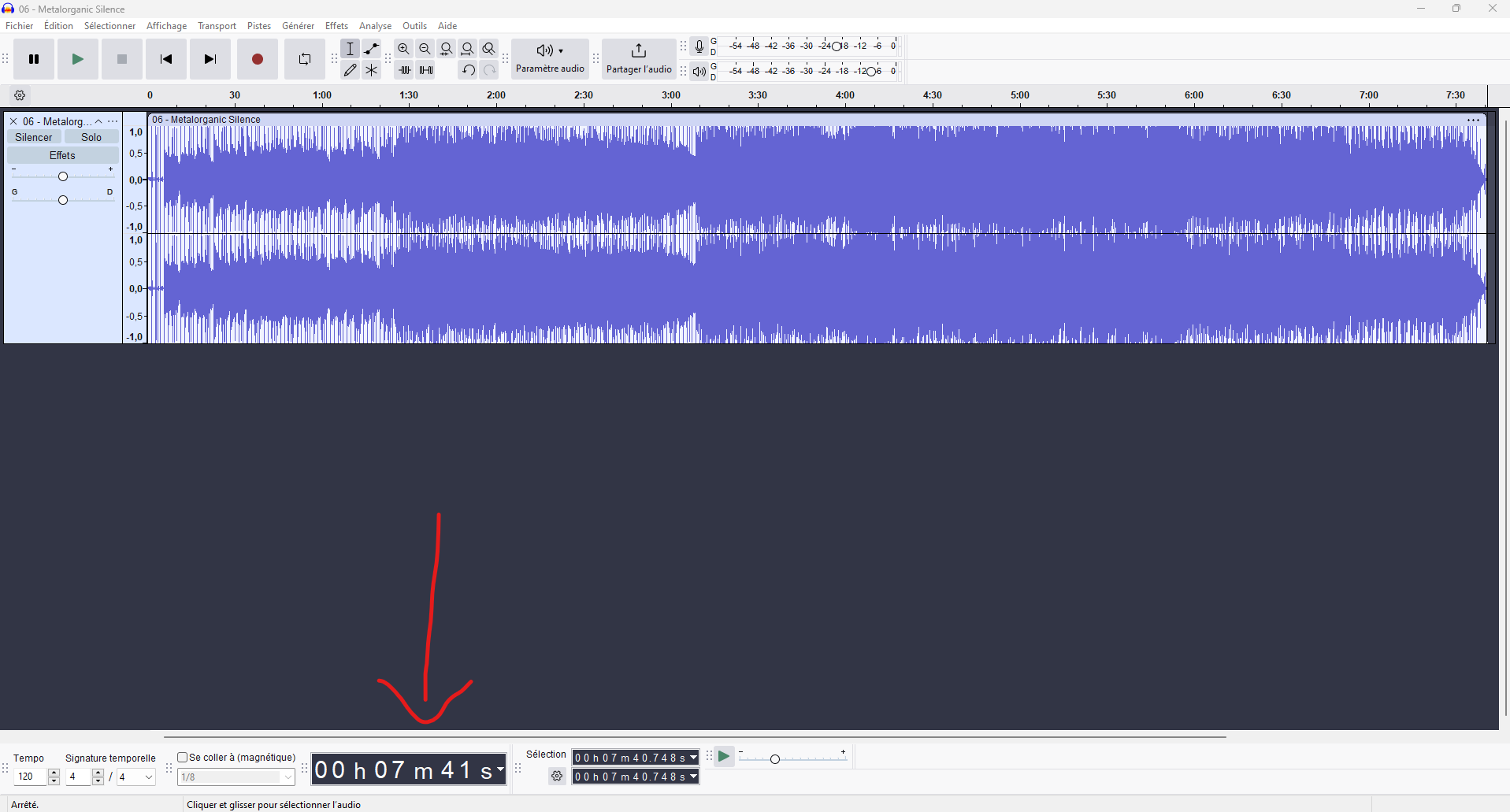
When your composition lasts 7 times longer…
So here it is, I opened my original demo and by default the length is 7 minutes and 41 seconds. The real challenge begins now because it will be necessary to reduce the size of this demo by 7 times to capture its essence and to make it explicit enough for SUNO’s AI to be able to reconstruct a version that holds up and that is close and respectful of the original material… Well yeah, because otherwise you might as well do without the original material and go straight to a clean generation that starts from scratch… Except that it will move away from the objective which is to rewrite and reinterpret the unfinished demos of the time, so not to use the original sound well… It’s not the same thing! It still has to be possible and we’ll see later that sometimes… Well it’s just not possible to do otherwise! On the other hand, here, we should be able to get there even if there is a constraint to take into account which is far from trivial: for the piece to be generated from the piece we are going to give it, it must start with this piece… that therefore means that we will have to keep a few seconds for an intro and avoid the “patchwork” effect of superimposed riffs… Suffice to say that we are going to have fun. It is 3 minutes past midnight and I am going to start preparing my file… We will see how long it takes me to finish it!
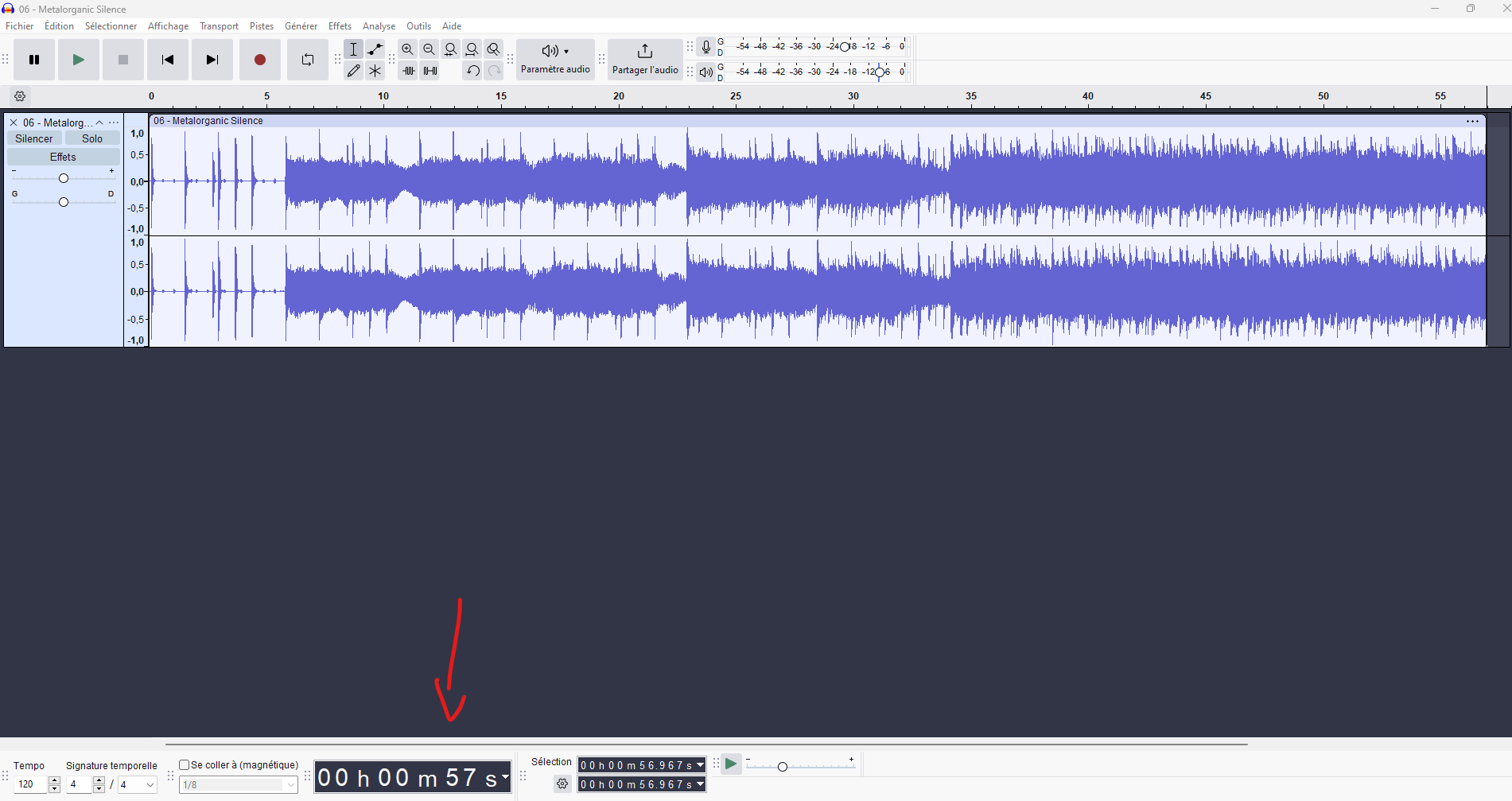
…and you reduce it to its simplest expression!
It’s done. It’s midnight 22, I worked relatively quickly but I couldn’t do much. Indeed, on this composition I have a kind of solo that accompanies the song throughout its duration and that plays in the foreground melodies that are similar but that are sufficiently different depending on the part of the song. “Metalorganic Silence”, it starts super-slow and if the drum machine always remains fixed it’s the rhythm that speeds up the song. Typically it’s an auditory illusion effect: we have the impression that the song goes faster and is more rhythmic but it’s just that in fact the number of notes played goes from 1 to 2, then 4, 8, 16 and ends at 32. AI could even go further but for a human 32 is already hard to keep constant over time… I’m not even talking about the difficulty of switching from one to the other because that still means that we master two rhythms: the one we play and the one of the drum machine that serves as a reference. Believe me, “Metalorganic Silence” is a real auditory experience… The problem is that I would have liked to keep a period of 1, one of 2, one of 4 etc. but if I do that it will be a patchwork and sticking a 16 or a 32 behind a 4 is disgusting, especially with the solo that doesn’t play the same thing… So I kept the concept of 1, 2 and 4… let’s hope that the AI can grasp the concept and spit out something that doesn’t do 1 2 4 1 4 2 4 2 1 otherwise it will be slow, really slow… And it will ruin the concept of the song! Afterwards, the AI is not in my head; it will do with what I give it but frankly 60 seconds is really not enough! If at least we could tell it “Ok, that’s 60 seconds for the intro, that’s 45 seconds of the verse, that’s 27 seconds of the chorus and that’s the 37 seconds of solo” that would be great! We wouldn’t have to rack our brains to create a sample that requires an intro, is limited, and doesn’t allow us to do what I just mentioned. Come on, let’s have fun with the sample we just created!
14. Building with SUNO – Part 2
Before throwing yourself headlong into generating songs, there is one more essential step in the process. You will have to write lyrics! Well, for most of the old compositions the work was already done and needed some touch-ups… Indeed, my original English is absolutely disgusting and I have committed many atrocities. When you don’t realize it, it’s not serious in itself but when real English speakers tell you “uh, there you actually used the wrong word and suddenly it doesn’t mean anything anymore” well you have to admit that it’s annoying and that you come across as an idiot. So even if it happens to me more than is reasonable (to come across as an idiot), it must still be emphasized that despite the “yogurt” side of some of my lyrics I still try to check the meaning in Google Translate. Some will say “Google is shit, it sometimes translates crap to you”. I am aware of this and that is why I write it in English so that he can translate it into French, then I do a language exchange, I correct if necessary in French and then I go back to English. Normally, in 3 times I manage to have a text that is practically correct and that holds up…
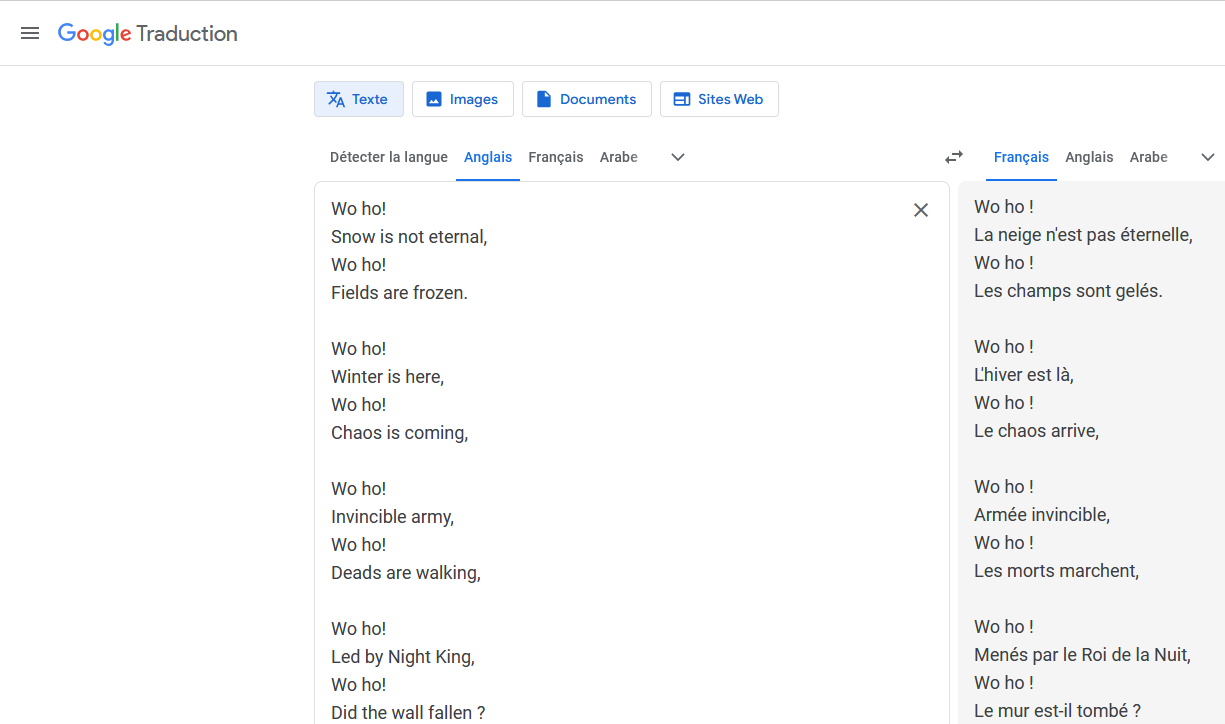
A text written with Google Crade 😉
Yes, it’s paradoxical because I write my text in English first but on the other hand, we imagine the singing in English so the rhythm of the singing will fit the rhythm of the song (and we will generally do this by listening to the song while we write the lyrics). So obviously, we start from the original song and not from the example that we have prepared and which in any case will serve as an instrumental introduction before we attack the singing… Unless we are dealing with an instrumental and in this case there is no singing or if we like groups like ISIS who can slam a 6-minute song and only sing for 1 minute in the whole song and again towards the end. And the R.E.P.L.I.C.A.T.O.R.S. is exactly in this style that it was thought… Conclusion? We wrote lyrics but they will not be used right away! We will first use our sample, then build a first instrumental generation which will give us the direction to follow…
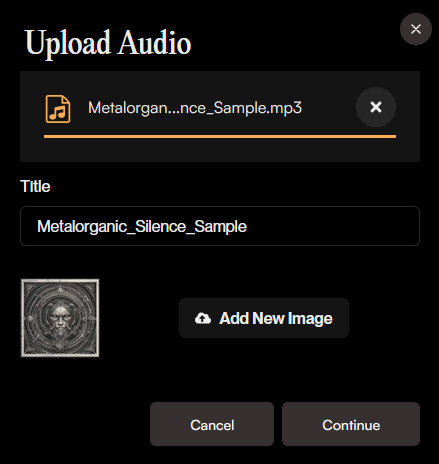
And there you have it, a new 57 second sample has been loaded!

This is the starting point that will need to be extended. Don’t forget to click on [Extend]!
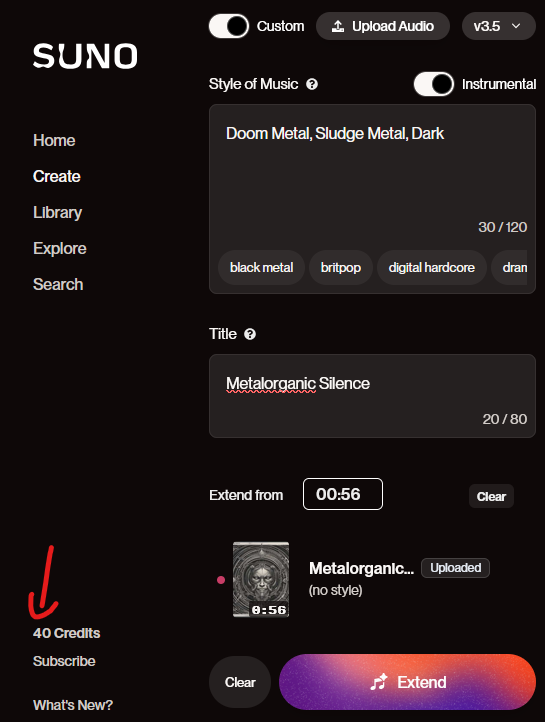
We’re going for a custom, instrumental, with a killer style and a classy title… and 40 credits, what a shame!
And from now on, we’re really going to get into the heart of the composition. We’ve chosen our musical style, our title and we’re starting from our 57-second demo which lost 1 second in the process but it doesn’t matter. The idea is that now we can already see the generations that are offered to us. And we’re going to have to wait a little if we want to listen to it in full, the time for the AI to generate it in real time. So when we have a fiber connection, it goes relatively well but with a less good connection, it’s better to wait until it displays the generation times. Another detail that is important: when I load my “sample”, SUNO will automatically do a copyright check… Indeed, they take artists’ copyright very seriously (even if that’s clearly what the RIAA is criticizing them for but anyway…) and it is clearly indicated that we don’t have the right to load tracks from a known song. So that’s good, because my demos, well… They’re not known so somewhere I’m not worried but I also know that I wouldn’t be smart enough to upload bits of copyrighted songs… If I do that and SUNO catches me, they can kick me off the site and frankly that’s the last thing I want… So, let’s see now what was generated!
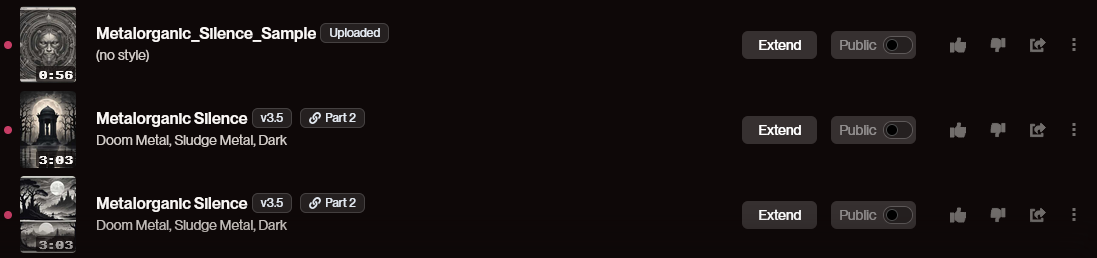
Our basic piece and its related suites (Part 2)… and from there, draw me a tree!
The generation is 03:03 minutes long… The first generation is and will always be 4 minutes long in version 3.5, so where do these 03:03 minutes come from? Well it’s easy: we started from our sample of 00:56 and if we subtract 00:56 from 04:00 well theoretically there is 03:04 left. Have I been robbed for another second? It’s quite possible but I think it’s more about hundredths and that suddenly we have the impression that we’re being screwed for a second when if we add up the hundredths… In short, we’re patting ourselves on the backside for the missing second… Now we’re going to select one or the other track (or even both one after the other) and we’re going to create a tree because each time we extend a piece of track, we’re going to create two possible generations… At some point, it’s going to become a treasure hunt to find your way around with a version, especially if we have fun generating everything in parallel… it quickly becomes hellish!
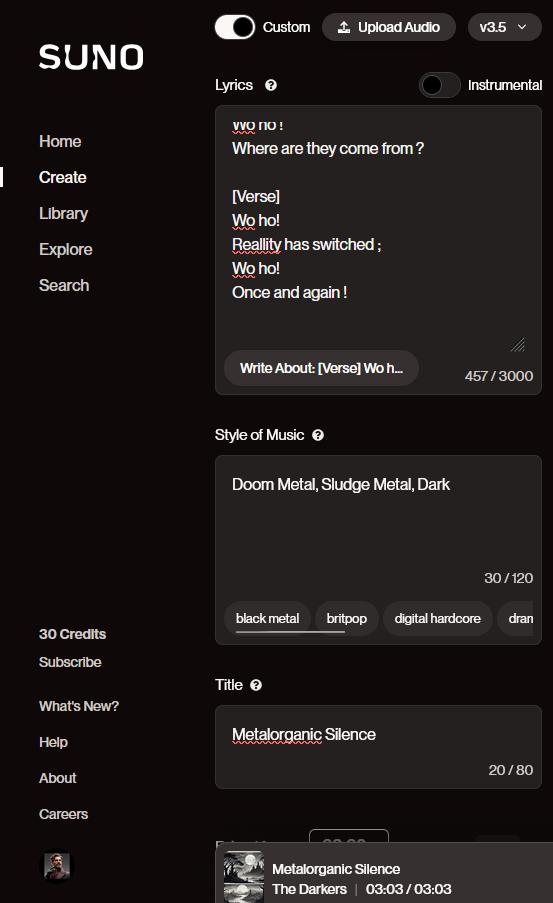
And we extend the selection to the new generated piece and so on!
I chose the second generation… The first surprised me because of some “wrong notes” in the way of rendering the solo… And the rhythm remains on 2 beats and it’s annoying. In the second generation, there is less of this “wrong notes” effect and the rhythm is closer even if we remain on 4… In short, the AI partially followed my idea and so now I just have to extend this instrumental part by putting my field there. Two remarks: all the following generations will be a maximum of 2 minutes, so there is no point in loading all the text if it is long, it is better to cut. On the other hand, I added structural elements to the song; here they are essentially [Verse] or verses but it will be hard to slap a chorus when the song itself is a kind of loop on a single riff which evolves in rhythm and in sound complement… If I had to compare it to something, I would say that it is close in construction to “Ravel’s Boléro” without equaling its form or power… But the idea is there and we will see what it will give!
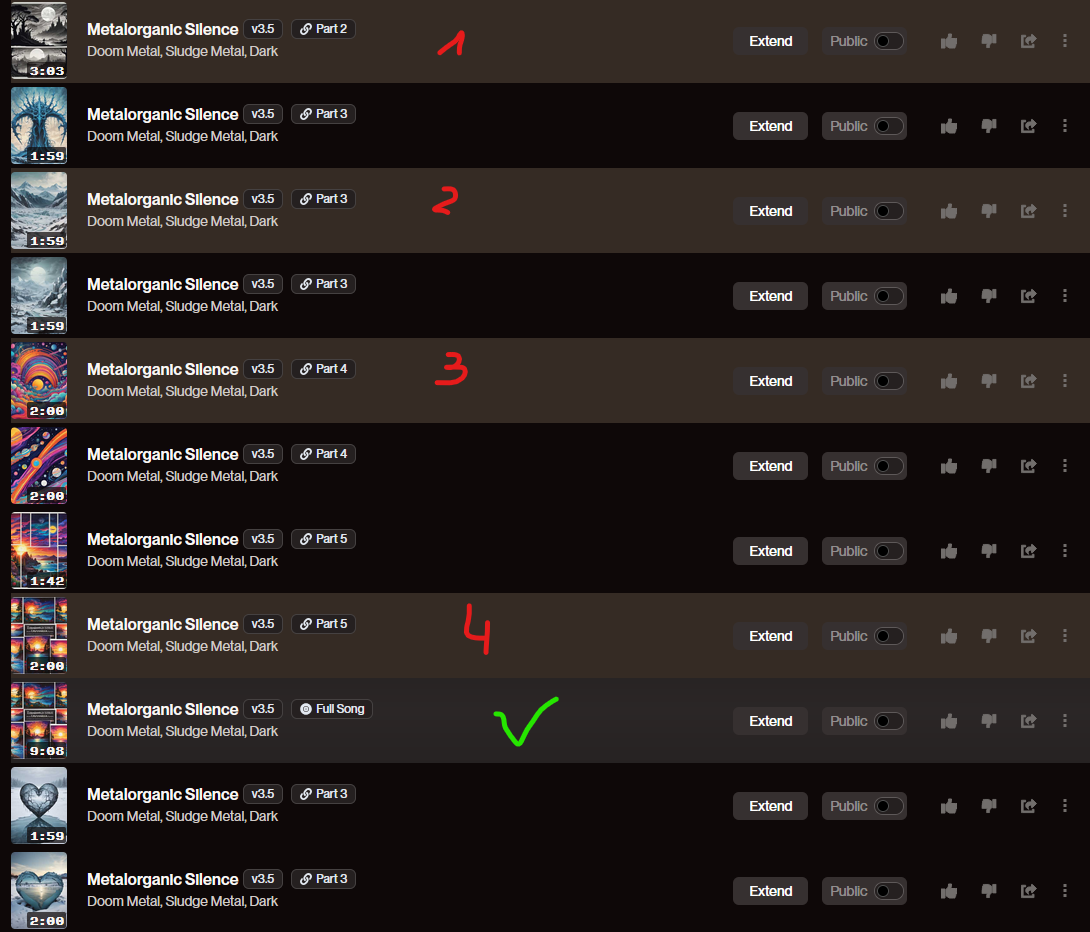
Once we have all the pieces, we concatenate!
The last operation is when we have found a satisfactory ending, we go to our last part and we tell it “Get Whole Song” and all that remains is to wait for it to go well… In principle, there are almost never any generation errors unless we push the cork a little too far in a generation. Like when we ask him for a 25-minute version in 13 songs, father SUNO tells you “no no no sir, it’s not possible, I’m timing out on execution because it’s too long and it’s cluttering up my servers… If you want to do Jethro Tull (This is a Brick, 00:43:46 or more than 40 minutes THE song) well you’re going to do it somewhere else because I’ll bug you in the face and I’ll throw up your mentally ill style”. There you go, it’s said: we can’t do monumental durations and that’s bad because I have a song that goes… Okay, I’ll shut up… “This is an Agglo”. For those who know, here’s the idea!
When you get hard after reading this article…
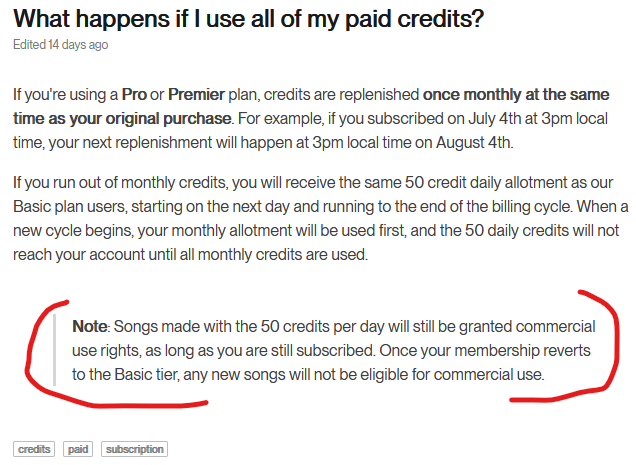
In short, I managed to complete two versions of Metalorganic Silence in “dry and without credit” mode, but that’s what’s sometimes magical with SUNO: you take a PRO subscription, you burn all your credits to make the subscription profitable and then when you’re dry 10 days after the beginning of the month you learn that SUNO has decided to give 50 credits per day to broke people who have burned all their credits… Better: the songs made with these extra credits count as marketable if the subscription is active! It’s wonderful, because it means that even when I’m out of credit I can continue to move forward a little more every day towards achieving my goal! THANK YOU SUNO!!!
