
Summary of the previous article
So in the previous article I loaded the dose a bit but I must say that it is a bit like my guide that I am creating to remember how it happens when we have to do all this. Imagine: I start from scratch, I have everything to discover and I will have to reproduce all these operations or at least most of them over time while I am not even really sure of doing it correctly from the start.
That said, it is educational and I find it interesting to be able to share the journey of someone who wants to enter the world of music after having more or less left it a few years before… Things have evolved quite a bit and with artificial intelligence we have reached a level never equaled until now in terms of musical creativity. In any case, that is how I see it since AI gives me all the power to do exactly what I want to do, within certain reasonable limits nevertheless.
A “dirty” or insult-filled text will always have a harder time getting through SUNO’s censorship, but hey… Musical waste is a hard drug and it’s hard to do without it, even if sometimes it would be necessary for the good of all our ears! Nevertheless, I must admit that in terms of waste, the trend is more towards recycling than wild dumping and it seems that what passed for musical waste can ultimately be valorized. Like what even when we make shit…
In fact, I don’t feel like I’m making shit anymore; in reality, I look at what I do and what I’ve done with a new angle of view. What I did until now has always been a base that could be sublimated and I’ve never hidden it. From my point of view, the best compositions I’ve made are those where the other musicians have brought their talent. It is their contribution that has allowed me to transform and sublimate certain compositions that have come to fill the repertoire of the different groups that I have set up or participated in. Today, it is the AI that has taken over… and I am all alone at the helm!
Are my initial compositions always sublimated or are they still valuable waste?
18. Valorization of musical waste
You have the right to think that I am a provocateur and that I am deliberately acting in bad faith when I talk to you about my compositions and tell you that we are very close to musical waste. First of all, you must understand that what I call “musical waste” is above all a composition that is not usable as such. Music that you could not make the public listen to for various reasons: the musical arrangements are not finished, instruments are missing, there is no singing, the quality of the recording is poor, the track is cut or interrupted by something or someone… In short, there is no shortage of reasons to describe it as “musical waste”. In reality, apart from the Live, the studio (or home studio) demos and some rehearsals with a mixing desk, we can consider everything else as “musical waste”… And that’s almost the whole essence of the PrEvIoUsLy UnReLeAsEd albums which are collections of musical waste, especially up to volume 4.
“Truth”, in its 1998 version PrEvIoUsLy UnReLeAsEd
Here is a perfect illustration of what I define as “musical waste”. In “Truth”, there is only the guitar and the bass with a saturated sound for the bass and a guitar sound that has as much power as an asthmatic mosquito. It is “noisy” or even “moldy” in good French in the text and that is precisely why I could not use the original track (yes yes, there are no others, it is the only one I could recover after two losses of hard drives and the impossibility of replaying certain CDs and even DVDs) to generate these compositions. I demonstrated it previously: we can start from a saturated track but at the output the result is disgusting… So if I provide crap as input, it is normal that I receive some as output. There is no magic or miracle in algorithms!
You will also note (or not) the absence of text or lyrics on this demo. Indeed, in 1998 I may have composed but I was only a bass player and not (yet) the singer of the band Metal Acid. So I didn’t bother writing lyrics since I wasn’t going to sing anyway (apparently). In the meantime, even if I didn’t write lyrics or sing anything on it, I still had my little idea about what this song was going to contain and since at the time I was already a maniac about archiving and saving traces of the work done, I took the trouble to do something totally useless at the time. I opened a very small file of a few kilobytes called “Ze BOOK of NOTHING (and all)” in which I recorded some information on the songs of the very first PrEvIoUsLy UnReLeAsEd… about “Truth”, here is what is indicated:
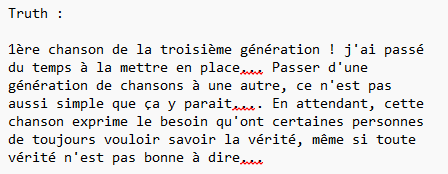
Last modified on May 11, 2000 at 08:06. It’s not very young!
Before you ask, I considered that there were three generations of compositions before making the first PrEvIoUsLy UnReLeAsEd. The first generation were simple songs in French on 2 or 3 chords maximum; it was really the beginning and it was necessary to start with something in composition. Obviously, it is the generation of recordings in a hurry as one can when one can with all the disadvantages that go with it: disgusting sound, saturation, pains (and not just a little) and then in terms of singing, we can already understand that I am not a born singer! Crécelle d’Argent 1998-1999 in authentic mode. Any doubts? Proof:
First generation song: “Vomir”… enjoy, it’s a gift!
So we will agree on two points if you think that it is very simplistic and that songs in French are to be avoided in my case. You will also have probably noticed the characteristic breath found on all the recordings of this period which violently disrupts the AI which considers it as an instrument in its own right and which then generates tracks saturated with breath… In short, as I said, we had to start somewhere and the almost 200 “songs” of the first generation still allowed us to progress to the second generation of songs. How do you define this second generation? An excerpt would probably be welcome:
Second Generation Song: “The Top Of The Hill” – Acoustic and guitar.
The gap between the first and second generations is quite wide. We went from compositions with 3 or 4 chords to much more structured compositions composed of 3 or 4 riffs or even more in some cases, with an intro, bridge and outro between the verses and choruses. In short, it is still much more structured and we left the singing aside to concentrate on the music itself. This still does not exclude the breads, the breath and the saturation of the instrument itself but at least there is a real progression and a real attempt at composition. In the second generation we no longer make songs for fun but we look very seriously at the composition and we start to write a large part of the titles that we will find in PrEvIoUsLy UnReLeAsEd I. The difference between the second and third generations? Multi-tracking, to superimpose the guitar and the bass (at a minimum) or even two guitars… In composition, it actually represents one more step in composing for other instruments.
Humbly, you can notice that I started with not much: an acoustic guitar and an outdated recorder… And then gradually I equipped myself: first the bass, then the electroacoustic guitar and later the ultimate multi-effect pedal which allowed me to compose more cleanly and achieve a demo quality that went from “musical waste” that was barely usable to “basic demo” or even more… There is indeed a question of quality of material to consider in addition to the quality of the musician and his productions. You can make masterpieces but with a disgusting sound you will get crap thrown at your head… And paradoxically you can have a great sound and make shitty songs and still have an audience that follows you. After that, tastes and colors… that’s it! What I say is that it took me 3 generations of songs to get to the first PrEvIoUsLy UnReLeAsEd and that it has an abominable sound that I can’t reuse to redo the first compositions. You heard “Truth” and you know that it’s the truth (you can’t say otherwise, otherwise either you’re deaf, or you’re Auvergn…uh… in bad faith).
When you make a bad pun and you think you’ve overdone it a bit…
In short, it is clear that for the albums PrEvIoUsly UnReLeAsEd I, II and III I will have to start from new bases because the current base is not usable. It would be necessary to re-record everything with the current equipment but it would be extremely time-consuming, especially since the re-recording would then only serve as the basis for the regeneration by the AI. It would therefore be a huge waste of time, especially since the AI would perhaps not generate the composition in the same way as the one you would have recorded… Because the AI is not you: It simply takes what exists and imagines a way to implement the sound that was given to it. And if we don’t give it anything, it will generate anything in the requested style. And if we give it lyrics, it will strongly influence the style itself. This is also what I did with “Truth”; first write the lyrics of the song:
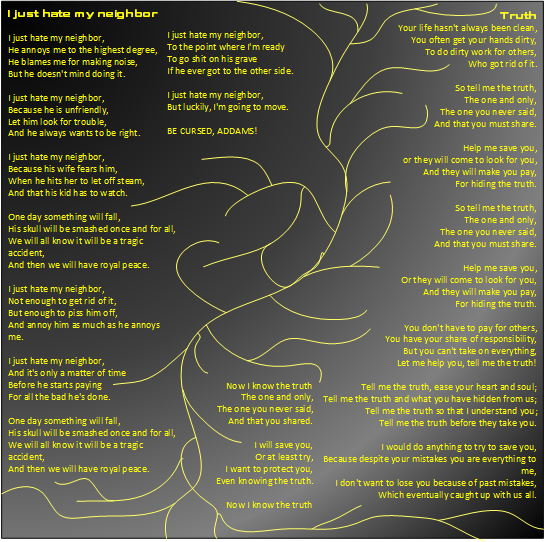
When you make your own cheap covers 😉
The lyrics of the song are one thing… Then, it is also preferable (even if it is not an obligation) to give it a structure to prevent the AI from going off the rails or to mark the intensity of certain passages. Obviously, at this level my reference is clearly the SUNO Wiki which, even if it is a little old and does not contain everything, is still sufficiently provided to have the elements allowing to make a structure that holds up. And there, for most of the song constructions it remains quite classic and modeled on the same model, even if later on at the level of the constructions I tried to build things a little less classic… In any case, here is what it gives when it is prepared:
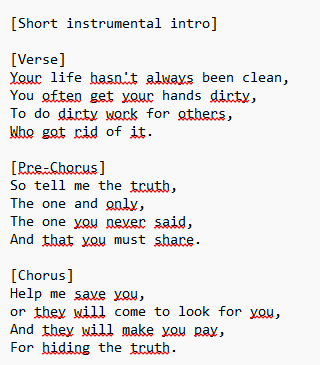
Defining song structure in SUNO, long live hooks, captain!
And the end result, you might ask? Well, that’s one of the many questions we’re entitled to ask ourselves because, in fact, once we know what we started with, what we’ve reworked and retouched and the fact that the original recording is unusable, we’re really entitled to wonder what the result was… But to know that, we first have to talk about the rest of the operations and believe me, you have to have done it once to understand how complicated it can sometimes be to embark on operations that you’ve never really tried before…
19. TuneCore (or the joys of online distribution)
Well, we already talked about TuneCore and the principle of publishing material (the declarations to be made, the ISRC and all that). I told you at that moment that the most important thing was going to be the judgment of my peers. The TuneCore musicians who will verify and validate my material… And that’s where everything will be played out because if you remember what I told you, for it to work with AI, it really has to be personalized, there has to be something at the level of the sound and/or the lyrics, an artist “touch” that is recognizable and with AI, it’s not always easy to obtain this “touch” even if the AI takes into account the lyrics, the structure and the musical styles. I still have the impression that by dint of training her to make compositions for me, she is starting to know me well enough to understand what I like and what I am looking for and thus bring out what is close to my “style”… Because yes, I do have one!
To those who doubt it, know that when you have typed 10 years of compositions there is a way of composing that is created. A style that evolves, searches for itself, refines itself. In the end, we end up developing a sound that becomes its trademark… For me it has become the saturated rhythmic guitar, the heavy bass and a guitar in effect on top with usually a drum machine. My rhythms and a few gimmicks that come back quite often are also a trademark, as is the non-standard tuning to make people who have been to the conservatory yell. So can the AI emulate my “style” or will it flop and generate preformatted mush for me?
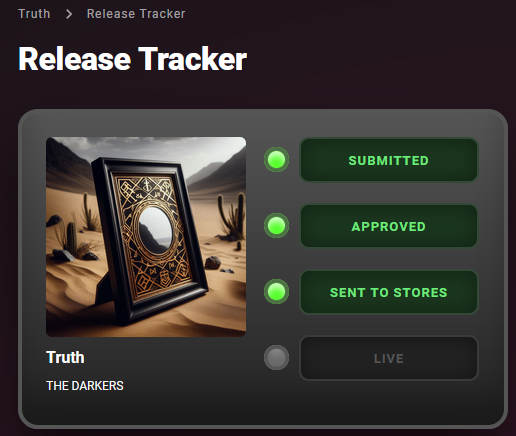
The first time, it’s hard to believe, and yet…
Well, looking back, I want to say that we are far from a pre-formatted, infamous mush. I even think that we are on something that is not always conventional and it is frankly not so bad since on the first 3 albums I was hardly able to recover enough to feed the AI. The sound of the original recordings is not clean enough to succeed in making tracks without saturation and so at one point, I was forced to have the AI redo most of the total generation at the musical level even if in terms of lyrics and structure it was me who fed it. It seems that this is enough for my first EP to be validated by TuneCore and sent to the stores, knowing that it will not arrive for 4 weeks… That is to say on September 30, and I do not even know if it will really do it. To tell the truth, even if TuneCore says “OK” and sends the music to the stores, there is still the possibility that the platforms decide to censor or not broadcast the songs… So nothing is a given in advance!
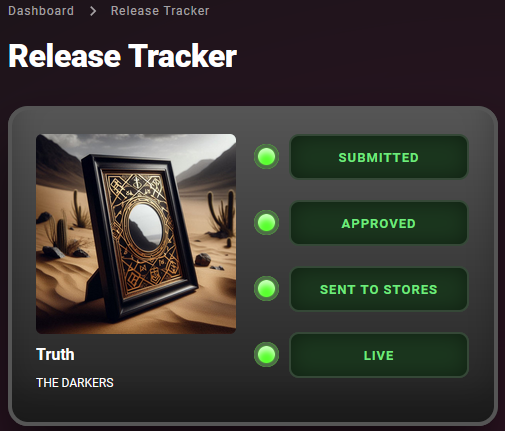
…when we tell you it’s online, it’s online!
But there, for the first EP it seems that I am extremely lucky: It went through TuneCore but also on almost all the platforms… We check on iTunes, Spotify and Amazon:
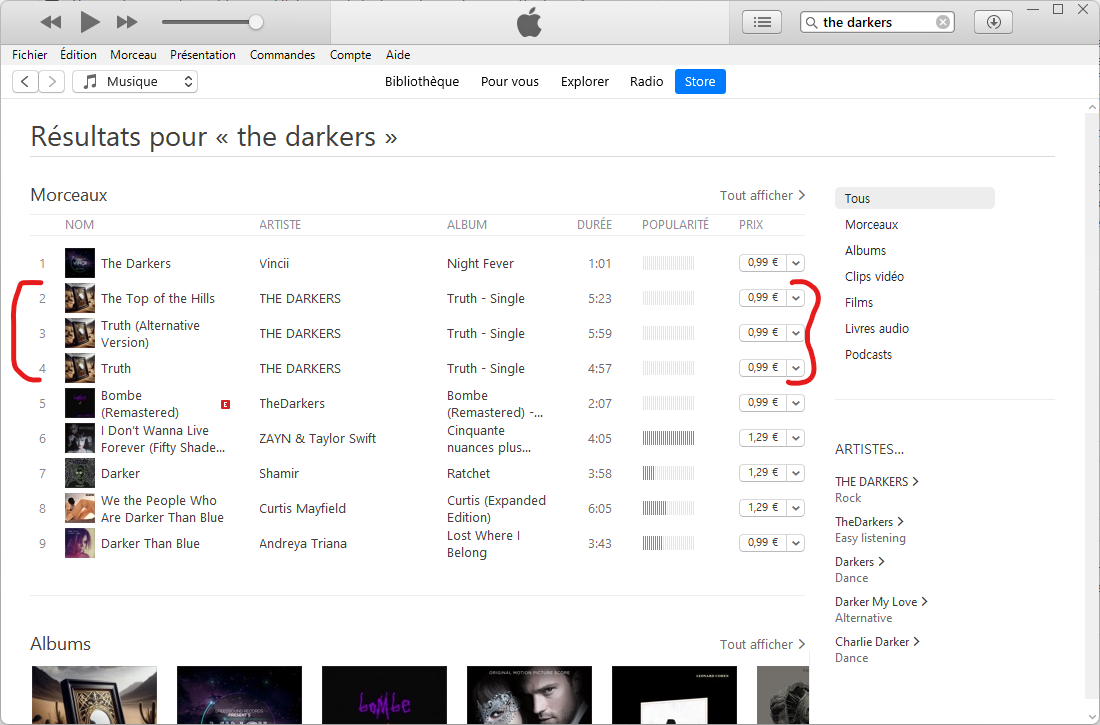
In the sect of the worshipers of the bitten apple it is OK…
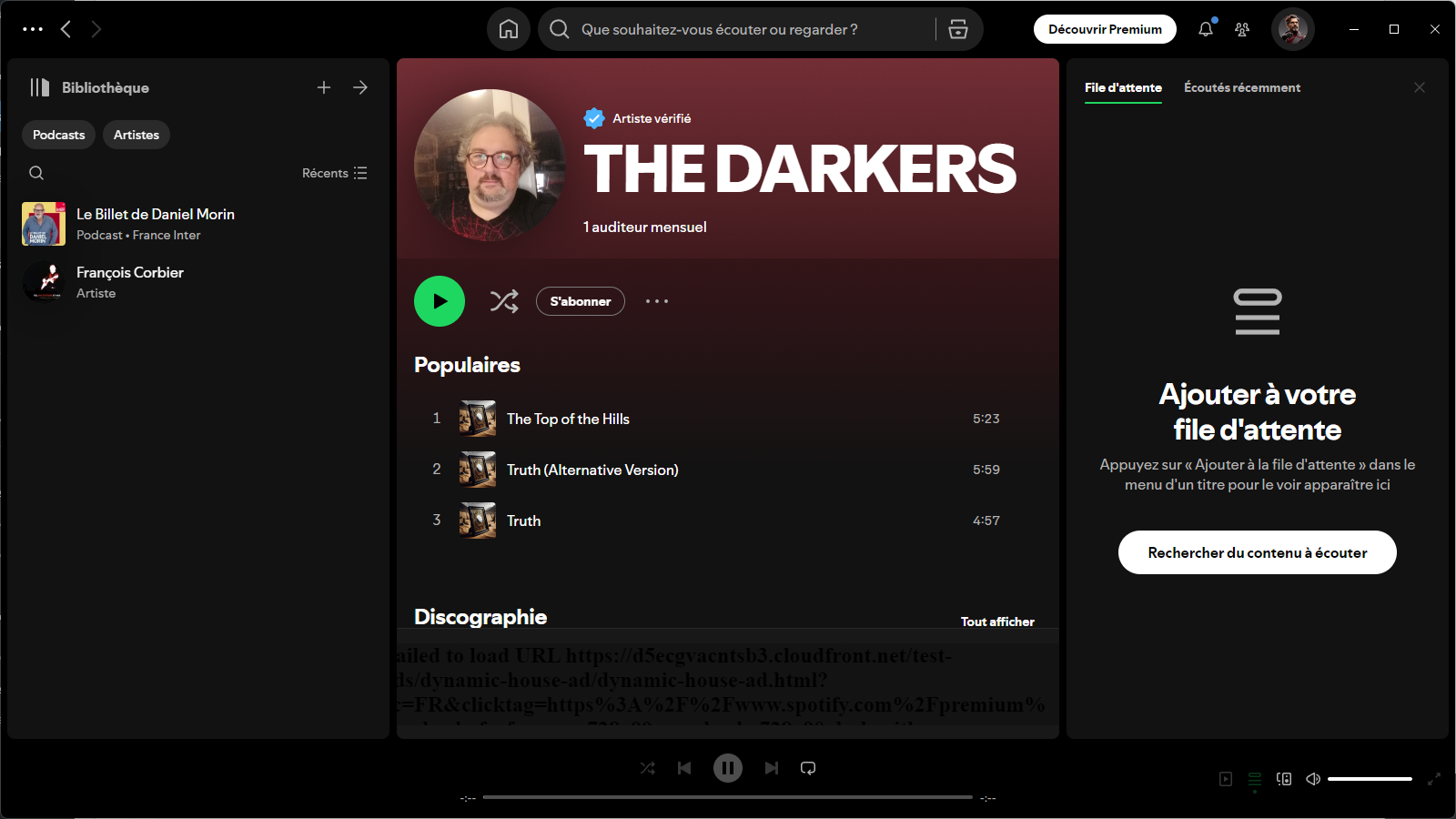
…at Spotify it is too…
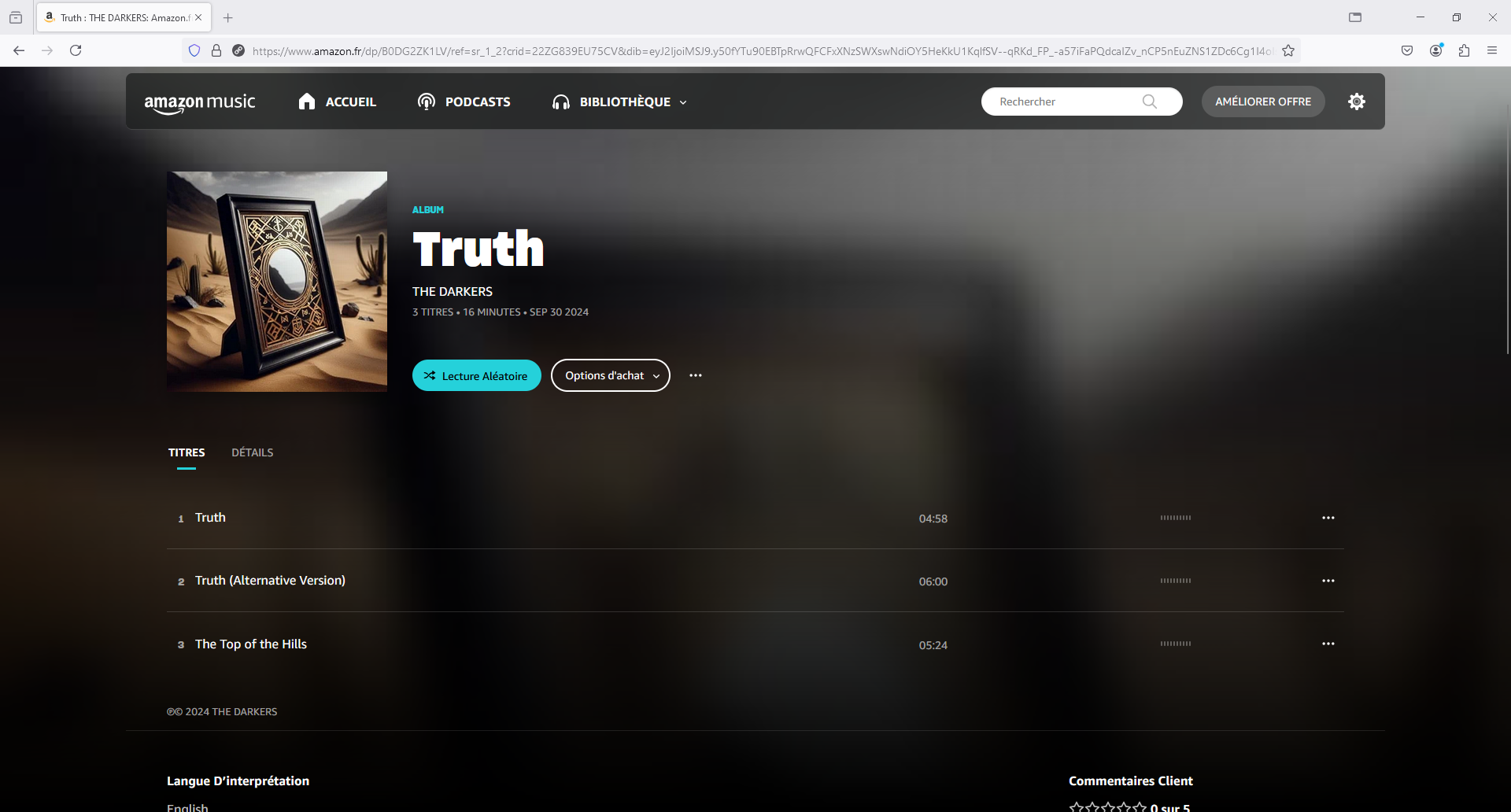
…and at Amazon, it’s in the boxes!
So there you say to yourself “well ok, that’s it, it’s over!”. Not at all! If you think it stops here it’s because you haven’t understood that the next step is to promote your music on social networks, build a community of followers or at least people interested in what I do and who will at least listen to my music even if they don’t buy it… Yes, listening time also brings in a bit of money but I admit that I don’t really master the process yet. On the other hand, I’m still going to have a lot of work because the distributor didn’t make fun of me: my tracks were delivered to the different platforms as I prepared the package but but but… Each of these platforms has a specific account for artists and there I’m going to have to claim my profiles… Oh well yes, if I don’t do it it sucks!
The problem I have is that to access “Apple Music for Artists” and “Spotify for Artists” I have specific buttons on TuneCore… For “Amazon Music for Artists” the link should work but we’ll see… It also means that I’m going to have to take the time to update my profiles on these platforms in addition to preparing this site and making my YouTube channel and promoting it… Well yes, because there’s that too: I can map my YouTube channel directly to TuneCore but for that I need 15 subscribers and I have… 0! My channel has just started and I have no content other than SUNO’s videos for my songs. By the way, here’s what “Truth” looks like in excerpt:
By default the sound is in mute mode. Clicking on it reactivates it… Enjoy!
