

Can Generative AI Replace Musicians?
1. Once upon a time, I was a musician…
Yes, I admit that when I was asked this question I was skeptical right from the start. Indeed, I myself was a musician between 1998 and 2008 and at the time we didn’t talk about artificial intelligence or image and/or video and/or sound generation. But time flies and 16 years later it’s not quite the same story anymore!
So let’s try to understand what has changed since then and why it is legitimate to ask the initial question of this article! First of all, we must keep in mind that for artificial intelligence (AI) like all technologies that are on the rise, this generally only lasts if the applications of these technologies manage to integrate naturally into uses.
Inevitably, you will have heard somewhere about Chat GPT and maybe also OpenAI, the company that created GPT? Well, otherwise know that the PR stunt worked well and that more and more people are using Chat GPT for simple or more complex queries.
As far as I’m concerned, GPT mostly means that I ate Mexican food before (beans, Philippe, for those who still remember the reference) because I still have a bit of trouble using it. Indeed, it is a “prompt” system in which you just have to ask what you want and GPT answers us, with answers that are either relevant or totally crap…
2. The advent of AI and how it works
In fact, the relevance of the answers depends directly on who asks the question and how it is formulated. A “Prompter” used to be a panel on which text scrolled. Now, it is almost a profession in its own right! As for GPT, it is only one of the dozens or soon hundreds of AIs that can answer questions and generate text, scripts and even simple application developments!
And next to GPT, we have the possibility of using Midjourney to generate images from text descriptions (the famous “prompts”) or Dall-E which is used by Microsoft’s Copilot… And there, you start to say to yourself “Ok, we generate text and images, what does that have to do with music?” Well, I’m getting there! Know before that there are even tools to generate video and that it is extremely promising to the extent that we can really do more and more complete things from ideas put into form. InVideo AI does this very well for example but it is far from being the only one!
And then, we generate text, images, video…And even music with SUNO! And there, you should start to be relatively skeptical because music is part of the somewhat special arts for which a certain sensitivity is required, particularly in terms of composition. Besides, beyond that, there is still the dominant philosophical question that should normally reach your mind if you have one in good and due form: What differentiates us from Machines?

SUNO, a music generation platform
4. Take a step back and look at things from a new angle.
Okay, let’s imagine that I’m a musician (I was, but I often played out of tune, that’s why) and that I decide to make a composition on SUNO. Knowing that I can take a guitar and do it myself, we agree that the interest is very limited?
Okay, now, if my basic style is alternative rock and I want to compose Heavy Metal. Will I be able to do it? Well, it will depend on my level, because Heavy Metal may not be within everyone’s reach, but technically it’s tough… it requires technique, dexterity and speed.
That doesn’t mean that I won’t end up getting there with practice, but it will take time to get started. Let’s say that I play in a band that has a pop-rock sound and that I managed to compose an epic Heavy Metal song, even an equestrian one with a unicorn in it…
You’ll already see the faces of the other musicians, you’ll understand that for them, it’s a real test that you’re making them undergo at the ear level. Then, either you took a can of beer to the head (because a real musician drinks and smokes sh…. uh… Cliché?) or they are civilized (they are not all punks either) and they make you understand that you can possibly wipe your ass with your composition if you wrote the lyrics and/or the scores because it will not fit at all with the style of the group.
Disappear with your moldy composition, you dirty metalhead traitor!
In short, you’re going to end up frustrated with your great composition that you would have liked to share with the group and you’re going to put it in a sleeve on the side, next to the recording that you made for yourself to remind yourself that you composed a song that’s a bit different.
One, two, ten, a hundred… After a while, you have so many compositions on the side that are unused that you could make whole albums of them… Except that all of that is in demo form and your musician friends aren’t keen on doing anything other than what they know how to do. There aren’t many of them who tell you “Try a new musical style? But of course, every day!”.
And then, you meet SUNO, and suddenly you say to yourself “Well, what if I tried to generate this composition through its lyrics and the style that I wanted to give it at the base?”. You set what you want, you launch it and then it generates two songs.

When you generated the song you had in mind.. by AI.
Result? Most of the time and if you have done your prompt correctly, your two basic generations include at least one that will satisfy you because it will give you exactly what you expected. A Heavy Metal song that you wanted to do but that no one around you wanted or was able to play.
So is it just a gadget for frustrated musicians? Well yes and no. Imagine that you want to write a song but you don’t know how to play music… Well then you don’t have to ask yourself the question because SUNO will give you the help you need to make something that is decent or even very decent.
Maybe I’m exaggerating a bit, right?
6. The musician’s contribution to AI
First, we need to clarify one important thing: AI does not compose by itself. It assembles elements that seem relevant to it in relation to what it has analyzed in what it has been given and then it makes proposals. When I am in front of the SUNO interface, I am the one who tells it what I want and how I want it; there is no question of letting it do a complete generation from a simple idea!
I give it lyrics and I choose the musical style(s) to use. Then, it submits two generations to me and I choose the one that seems most relevant to me. If out of 4 minutes I think that there are only 1 or 2 that are good, I will extend the song by making a cut from the point where I think it is less good. Then, I will start again as many times as necessary to obtain the song I want.

Generate, Select, Restart… Edge of SUNO!
So then, I am quite selective about the tone and style of the song, because concretely I already know what I want to obtain even if I cannot force the AI to do it for me as I would like. Nevertheless, I thought I noticed that most of the time with the appropriate lyrics and musical style, the machine will often hit the mark… I even sometimes have the impression that the machine analyzes my prompts as I go along and that it has learned to know my musical preferences for non-linear structures with breaks, bridges and instrumental interludes…
In truth, when you make music and especially composition, you always leave a small part of your soul in your creations, whether through the lyrics and/or the music… You transcribe this little bit of soul in the form of waves and either you are receptive to it or you are not. Authentic emotion is feeling that little piece of the soul of the person who created the song and it works from the moment there is a certain alignment or even a certain alchemy in the conception of a piece.

Admit that you didn’t see it coming… or did you? Oh really!
So of course, when you are a composer and you have a real sensitivity to this, you are totally allowed to believe and say that AI is devoid of humanity and it is true up to a certain point.
8. What if we reconstructed a piece of music from an excerpt from your demos?
When SUNO announced this, I was in a quantum state. Both incredulous and extremely enthusiastic. Because yes, generating music from lyrics is good, but if we can also give it the idea of the sound we originally wanted for the composition and it can take hold of it to reconstruct it and complete the missing instruments to make something complete… that’s the best!
So, we no longer have to wonder whether or not, as a musician, we can legitimately consider that we can or cannot use this tool (because it is an instrument like any other) to generate music and exploit it! Well yes, it changes everything to arrive with an extract of what we have composed and that the AI works from that. Now, we start with an extract of 6 to 60 seconds max that will have to be extended and there it gets hot.

When you realize that in the end it’s not going to work at all…
If you like instrumental introductions longer than 10 seconds, if your verse or chorus changes happen after 2 minutes or if you have bridges that make the music a bit charming, it’s going to be tight in 60 seconds, especially when you have to put all that at the beginning of the generation. If SUNO still allowed you to select several excerpts and define them as verses / choruses / bridges / breaks / interlude / solo and so on, it would be great because then the AI could use the initial material to rebuild a complete version of the song, including vocals.
Now, we have a limited time and a problem with the quality of the songs to load. The slightest saturation or breath effect will literally destroy the sound of the song over time. I tried to recover a composition from 1996 where there was a bit of breath and the result was great until we went beyond two or three minutes… Then the sound turned into an inaudible mush saturated by a breath generated by the AI. Because yes, the AI considered that the background noise was part of the song…

That’s exactly what it feels like when you realize he’s added some breath…
I tried the experiment several times with demos recorded with a stripped-down sound and compressed to limit saturation. For these compositions, no worries, it went like a letter in the post (although it depends on which post office…). The results are sometimes surprising since the AI will recreate the structure from an extract that does not always represent the entire original demo but it can be completely rotten or it can border on genius. And I am not exaggerating when I say that because in the course of certain generations we find gems and this is particularly true for instrumental songs.
So I am a big fan of long instrumental songs that have a particular sound that tends to make the mind travel or keep it in a state of concentration (you can do a lot of things with music) and I was a little bothered with SUNO before the appearance of this famous feature that allows you to load extracts and complete them. Whether it was for instrumentals or songs based on a particular key, I lacked this possibility, which had until then prevented me from giving substance to the idea that was germinating in my mind…

That’s exactly it… I have a plan but I need you to make it succeed!
In short, the new feature is in its early stages and it’s quite promising even if it’s limited for now. So ultimately, will generative AI replace musicians?
10. Beyond the article, a project that is taking shape
Do you realize that for the last 16 years I wanted to rework this entire archive and that given the colossal work that it represented I never really started? And then, I come across SUNO and I realize that everything I dreamed of all these years is finally possible and within my reach.
Okay, the result is not always perfect and in rare cases it is a bit messy but as I experiment with SUNO I improve, my generations are more precise and the results are much better… In fact, it is another instrument that I learn to use, no more no less… And what am I going to do with it? Well, I decided that it was time to resurrect the “PrEvIoUsLy UnReLeAsEd” project by going through crowdfunding on Ulule:

I still have to specify where this is happening, right?
I imagine that you have made the connection between the content of the article and the project in question. The advantage is that my job also consists of keeping myself informed of technological advances and determining their strengths and weaknesses as well as their advantages and disadvantages.
It seems clear to me today that AI music generation technology is at an advanced stage that allows us to embark on this type of project even if paradoxically it is changing and subject to developments that could radically change its operation or results.
That said, I am jumping on the bandwagon and invite you to participate in my project, the terms of which will be revealed to you shortly. Even if you are not directly participating in the project, you can sign up to be informed of its launch and learn more about what has been planned.
If I had to specify, it’s a project that’s starting soon…not long, really… It won’t take me 16 years this time!
I would like to give you the link to the Ulule page of the “PrEvIoUsLy UnReLeAsEd” collection and also the link to my personal website which will also be used during the crowdfunding campaign as soon as it is launched.
Registering does not commit you to anything, know that; it will only allow you to be informed of the start of the collection and its terms. For the rest, you have no obligation; I am only sharing my project with you which is in line with the conclusion of this article which, I hope, will have made you discover the technologies of musical generations and will have made you want to listen to what comes out of it, or even why not start composing?
And if you have decided to go and register, I’ll see you soon 😉
3. Terminator, Matrix, I Robot, Blade Runner, BattleStar Galactica and others…
You will tell me that I am still digressing a little, but I am just making a quick detour through the science fiction / fantasy box before returning to the subject of this article and I promise, it will not be very long. So if I ask my philosophical question of what differentiates us from Machines, it is because for a long time the answer has been “because machines are incapable of having the slightest sensitivity and the slightest capacity to produce something of their own that is artistically valid”.
Well then ladies and gentlemen, we will have to happily revise our definition because for some time now our musical AI has been capable of generating increasingly evolved and interesting compositions, musically speaking. So of course, SUNO is not the only music generation platform… There is also Udio which offers an identical service and no doubt quite a few others but with the current constant and regular progress of SUNO it is becoming difficult to ignore this application.
I found dozens of videos on the internet of people who have tested SUNO and who are musicians and if they recognize incontestably that it is quite impressive, they agree to say (and for musicians, tuning is something) that it is good but that nothing beats humans to give emotion.
Well you know what? I do not agree with them. I could have, but in all objectivity there is still always in the background this fear and this uncertainty in the face of the unknown and the novelty that characterizes the human species so well and that transpires in their feelings. You are brought something brand new and you start by rejecting it because you have the impression that it will encroach on your territory and change your habits!
Do I need to remind you, dear humans, that everyday life is a mishmash of lines of cause and effect that impact each other in a permanent order and chaos and that on this account by trying to rationalize your lives in a defined order you are doing something purely against nature?

Any of us can be human… uh?
In short, what I was saying is that humans are generally afraid of novelty and that they often feel threatened. Here, we have a musician who basically says “Suno? Yes, well, it makes hits but it remains a machine without emotions”… The other musicians in the other videos have the same speech and all point out the problem of “yes, but the machine was trained with real music, copyright, respect for musicians, all that…”.
Okay.
5. The interest of AI-generated music?
So here we go. As far as I’m concerned (and this is just my personal impression that only commits me), I admit that I have trouble distinguishing between what today’s artists do and what the machine is capable of generating. So either I no longer have a musical ear at all and that would be a rational and satisfactory explanation for everyone except me, or today’s artists make so much crap that even a machine can do better and that’s an explanation that holds up but that will attract the wrath of said artists.

…or just a little bit but it’s deserved, right?
Otherwise, we can also admit that progress in generative AI at the musical level tends towards an increasing level of quality, which in the long term (it could only take a few months) could equal that of current productions, which are full of auto-tune and effects that gently “robotize” voices. Moreover, precisely… if we compare this kind of productions to music generated by AI, I’m sorry to say it but AI is already capable of doing it in “low-end” mode…

No, we said “Low End”, not Batman…
After that, it’s not just a personal opinion but an observation: SUNO can sometimes generate very well-made tracks in which we clearly hear auto-tune and robotic voice. In reality, it happens when we make a prompt with too many things in it or requests that are too far away (like hardcore polka with a singer with a Mexican accent, there’s a good chance that the result will be a little poorly rendered). The music will be audible, relatively “clean” but the voice will sometimes be a little “tinkered”, hence the idea that in fact we are in the low end of what AI can do, because we can have cleaner generations than that!
Again, this is not to denigrate the work of artists but at some point we have to give credit where credit is due: Music generated by artificial intelligence has reached a relatively satisfactory level of quality that can clearly compete with current productions and apart from a few musicians who really have an ear, it will be difficult to differentiate an artist using auto-tune from a song generated by AI for the general public.

And that’s how we just made tons of friends for life 😉
To sum up, the interest of AI-generated music is to allow those who have ideas but not the ability and/or time to learn music to be able to make music that holds up. So obviously, it’s the door open to anything and everything, but having a little talent in music still helps to do something other than pre-chewed soup that is rather Mainstream-oriented… But how do we do it?
7. What AI imposes as a limit on musicians
If I tell AI to figure out how to “make me a song about politics and TV presenters who would do better to keep quiet”, the result will not necessarily have the same flavor as if I were the one writing “Hanouna, casse-toi” in slam mode with crazy rhymes like “The difference between a man and a puppet is that the first has only one word”.
But here’s the thing, I don’t really like French songs, thank you! I prefer to make crap in pseudo-English sprinkled with yogurt than French songs. A question of style, no doubt? In any case, through the text and the chosen musical style, we can still “feel” the presence of a composer because in the end, whether we use a musical instrument or artificial intelligence, it is only a means by which to convey and share an emotion, whether it is positive or negative, joyful or sad.
With a little objectivity and intellectual honesty, we can achieve (almost) anything…
Afterwards, I admit that artificial intelligence does not replace the contact of an instrument and that a musician who knows his instrument for a long time has a privileged relationship with it and this is also felt at the level of the public, as I have been able to realize on many occasions. And there is also the performance: not everyone is able to sing in tune and play in tune at the same time while being synchronized with other people who do the same thing.
But for those who know how to do it and who find themselves facing AI, there is still a big feeling of frustration. Already because the generation can think outside the box and can have access to thousands of different styles and then because despite all the information we can give it, AI does a bit what it wants at times and it is not possible to completely control it to tell it what to do.
I generate what I want, pitiful human!!!
The other limitation is in the lyrics that we will find it. You dream of writing lyrics about a woman who has more balls than men? You will have to find another formulation because well, there are some lyrics that are refused due to moderation. How to say? Hardcore is full of phrases like “you bitch, suck my dick” and yet… Even if it is in the codes of the genre (Listen to the 20 Thunderdome compilations or just one of the best-of and you will see that it comes up often, very often… It is almost cultural at this level) it is censored…
You will not have the right to proclaim your love of Humanity by destruction and pure and simple eradication because you have to be nice to your neighbor. I had problems with a song called “Burn (like the fire in the hell)” which gives the point of view of a nihilistic extremist who wants to burn everything, including himself… Of course, I saw the moderation messages go through dozens of times before I managed to get the song through by changing only a few lyrics, which doesn’t change its meaning in any way. On the other hand, I was allowed to play a “Fuck you in the ass (and go fuck yourself)” repeated over and over in “Take That Loser!”…

When you don’t understand how moderation is done on an application…
So there are still limits and everything is not perfect, far from it… but it is evolving! And frankly in the latest SUNO features there is one that literally blew me away and I will tell you about it before concluding this article!
9. It’s time to take stock!
So no, artificial intelligence can generate wonders, but at the base there is still the human who gives the initial input in his prompt. We cannot therefore consider that musicians can be replaced by AI. And besides, if we ever had to get there, I admit that I would be disappointed because going to see an AI in concert will never be the same as a band… You will no longer smell the fetid odor of sweaty bodies rinsed by the rain falling on your face while you have wanted to pee since you arrived and you have been stuck standing since the beginning of the concert… You will no longer passively smoke CBD and hashish at festivals and you will no longer smell bad beer cut with water… You will no longer be jostled and no one will try to hold up your phone or your belongings in said jostling in “oops, it happens” mode.
In short, I’m going to miss that side of waiting in front of the gates for hours before the concerts that you find at Indochine concerts with its campers who number themselves and arrive several days before… Are you a real fan or are you not, right? In short, I seem a little critical of reality but somewhere depriving yourself of a live performance with disgusting sound and musicians who make jokes that would hang you (hello Mr. Corgan, this one is for you) would be a real shame. Okay, I’ll stop being mean: I like going to concerts and fortunately, it’s not about to stop and the advent of generative AI in music won’t change anything.
So yes, it’s true, sometimes we can be happy to see that nothing has changed… or maybe it’s ironic 😉
What I see, on the other hand, is a world of possibilities that are opening up for people like me who no longer have the patience and/or the time to put a band back together to make new compositions. Were we talking about bitter old musicians? Ok, I’ll take a ticket for this category if it pleases you… Still, it’s true: once you’ve experienced contact with the public and connected over a few songs, well, it leaves a mark and becomes a kind of drug that’s hard to do without.
From concert to concert, you grow your fan base and build special relationships with the people who follow you. When you’ve experienced that, that exchange with the public, well, somewhere, it stays engraved in your memory and you can’t forget it. It’s the power of passion, the reward for what you’ve given your audience, for all the trouble you’ve put in. Sometimes the audience is not sensitive to it and sometimes, when you don’t expect it, the audience gives you a real ovation because they appreciated the piece you just played because at the time you did it, you put your guts into it.
Not that kind of guts… Although, somewhere the intensity is the same depending on the string you vibrate?
So there you have it. I experienced all that and I chose to stop because I was tired of composing for nothing. You rack your brains to make demos and when you propose ten in your group, it is possible that you will have between 8 and 10 left that will never be exploited depending on the tolerance and the ego of the other members of the group. There will always be among these demos:
-
- Demos that will not catch on at the level of the members of the group for various reasons (too close to an existing composition, problems with the lyrics, etc.);
- Those that are not in the style of the group and that would not find a place in the current repertoire;
- Those that are technically complex to implement because of a somewhat particular tuning that requires a change for all or part of the group;
- Pre-worked compositions where the group must align with existing material, which brings a significant creative constraint;
In short, you will have understood the idea: nine times out of ten you archive your demo in a corner and you do not speak about it again until the next group… and again, depending on the dominant style in the group, certain compositions will remain forgotten and those which were played in the previous groups are condemned to not be replayed in the next one. Bottom line? We remake new compositions in the same conditions to arrive at the same result: an ever-growing archive of unfinished or pending compositions which had real potential but which were left aside due to lack of human/human compromise.

And when there are no possible concessions, if it were possible to resolve the problems in Homelander’s way, that would suit some people…
So, when you no longer want to compromise and see your demos and compositions in a finished form, what do you do? A deal with AI! It does what you ask of it as long as it remains within its limitations but you are free to do what you want. You do Alternative Rock with a bit of pop-rock, experimental and you touch on the tip of the bass of Metal and you want to travel a bit, musically speaking?
I got on the SUNO train and I went for a tour of the different sounds, ranging from metal and all its sub-genres (black, death, trash, heavy, sludge …) to post-rock (apocalyptic or not) by revisiting stoner, grunge, punk rock and even gothic doom or even atmospheric. How can I tell you? I have more than broadened my musical horizons and some of my original compositions have become full-fledged pieces of music that have a little more than potential.
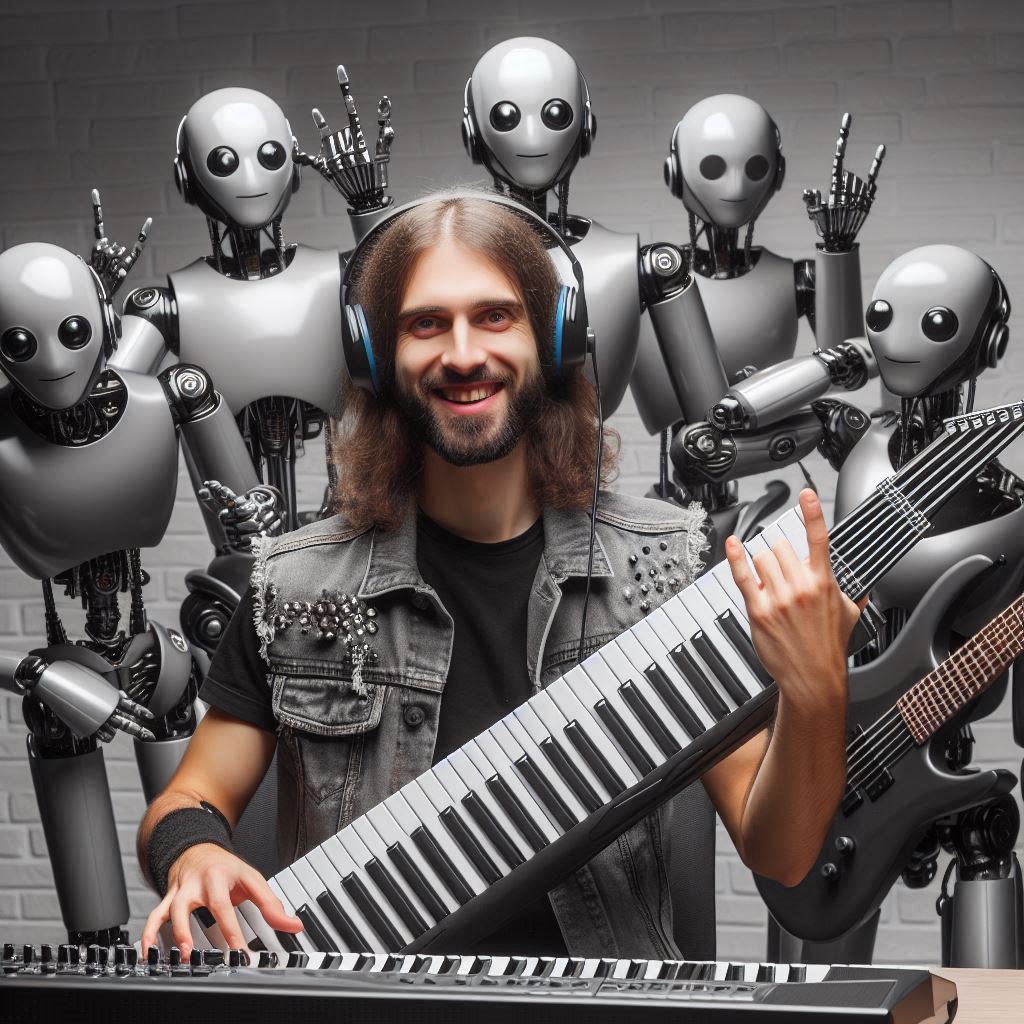
This is pretty much the image I have when I’m doing a prompt on Suno…
Really, you can’t imagine how rewarding and satisfying it is to finally be able to give free rein to your imagination without having to be limited by yourself on a human level! You can’t learn to play everything and you can’t spend your time switching from one instrument to another to compose your own music… It’s completely doable, but you have to master all the instruments and be able to put yourself in the shoes of each musician who should play the composition… I did that for a while and I promise you that I quickly stopped because it was leading nowhere.
The amount of effort to invest is enormous to finally be told “but sir, you will never be able to perform in concert with that, it can’t sell”. So of course, when I came across SUNO, I immediately understood the potential of the thing and what I could get out of it… I can already rework an audio archive of several dozen pieces (we’re not far from 200 anyway) but I can also create new ones and that opens up more than interesting perspectives since if I take a PRO subscription (at least) with SUNO, I can legally market the music that I have generated.
