
Summary of the previous article
In the previous article, I introduced you to the joys of failed generations and what they generate as unlistenable elements. Obviously, I especially emphasized the importance of having a good input sound in order to hope to have a “clean” and above all usable output and told you at the same time that my first three collections of demos are in a state that makes it difficult if not impossible to use them as a starting point for my compositions. It’s a shame and a shame because I would very much like to start from most of these demos to compose something close to the original work but when it doesn’t want to, it doesn’t want to!
I also explained to you that there were even possibilities of getting SACEMized but that it would take a little time since my first single won’t be released until September 30, 2024, that is to say in 18 days from now (well 17, since it’s going to be midnight in a minute…). In case you were wondering, my articles are written in the late evening / early night. It’s not even a question of inspiration but rather a question of availability… Indeed, having a private life and a professional life, having a public life on top of that is not easy every day and you have to keep a rhythm in the different actions over time.
Here, for example, I participated tonight in a contest on SUNO which consists of a remix contest. I said to myself “ok, it’s a remix, I vote for it in Hardcore, Speedcore, Gabber with a touch of Dark, it’ll go down great!”. Well, imagine that starting from the Synths version of the song, my hardcore has transformed into a kind of… Big nonsense that looks like cosmic crap but paradoxically it has a certain class! Yes, that’s not at all what I had in mind but I think the AI knows me now… She must have thought “yeah no, he’s currently into doom metal / sludge metal / dark so if he asks for hardcore we’ll serve him some kind of improbable techno / rap / metal mix with a bug passage and a cover that starts with “fucking”.
We’re on topic my darlings!
17. Distribution and registration
Frankly, music distribution is something that has always been far from my concerns, but then to a point where I did not even consider doing it one day and believe me if I tell you that there was a time when I really doubted the merits of my approach. Even when I was a musician and I really played an instrument alone or in a group, I had never really been interested in distribution circuits and their very particular functioning. I found a request for registration with SACEM that dates from the Neo Generis era and that was never sent… I’m not even sure that it was signed by Sybille, the young woman from the cultural center who had recruited us to do the animation on Freyming-Merlebach in 2002 and/or 2003, but in any case I know that the idea was there… But we had just had an idea that had not even been carried through to the end, otherwise I would have already been SACEMized at the time and I could have already made the same mess that I do today but worse!
It must be said that a lot of things have changed since then and that well, I don’t have the same determination today that I had when I was younger. Here I am alone on my project and apart from myself, I have no one to convince of the merits of my approach… So I don’t have to fight with people to get them to get off their ass and do things… I kick myself in the ass (that will please Optimus) to move forward and make my own furrow without scratching the vinyl! And music distribution is really an experience in its own right. So fortunately, things are largely simplified on TuneCore but you have absolutely no idea how long it will take or what you will be asked to do… And believe me, it’s not a lot of things but you have to think about it!

Sometimes it has exactly that effect on me!
Okay, I’m going to tell you a little about TuneCore, the famous music distribution platform that is connected to almost all the others. Let’s start by talking about Thunes… We’ll talk about the core later if you want!
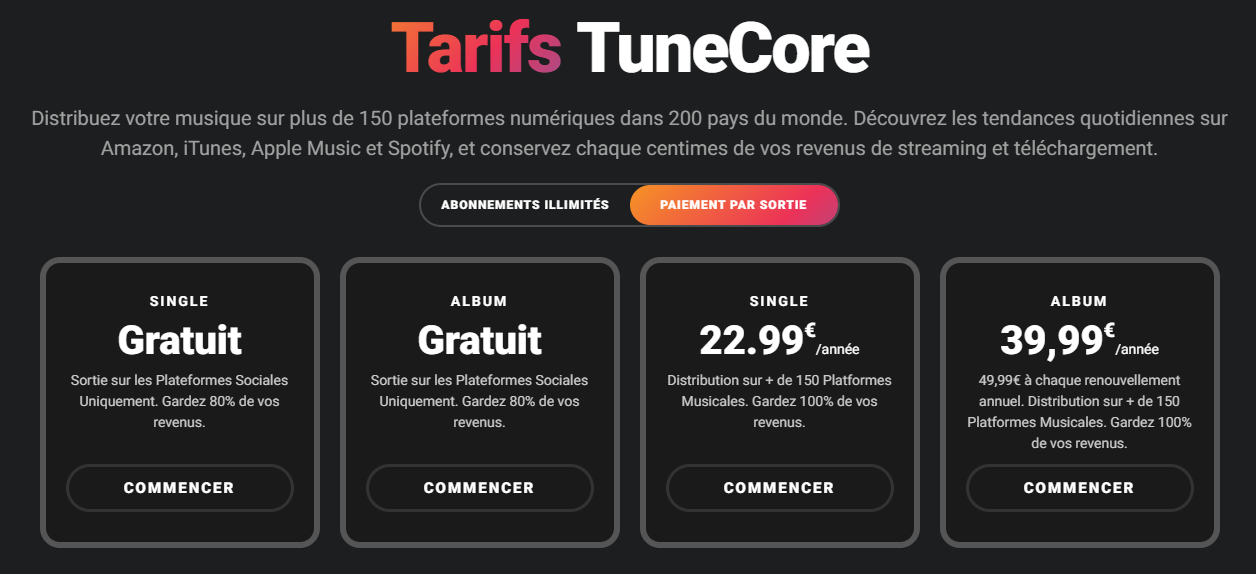
TuneCore’s old pricing is scary…
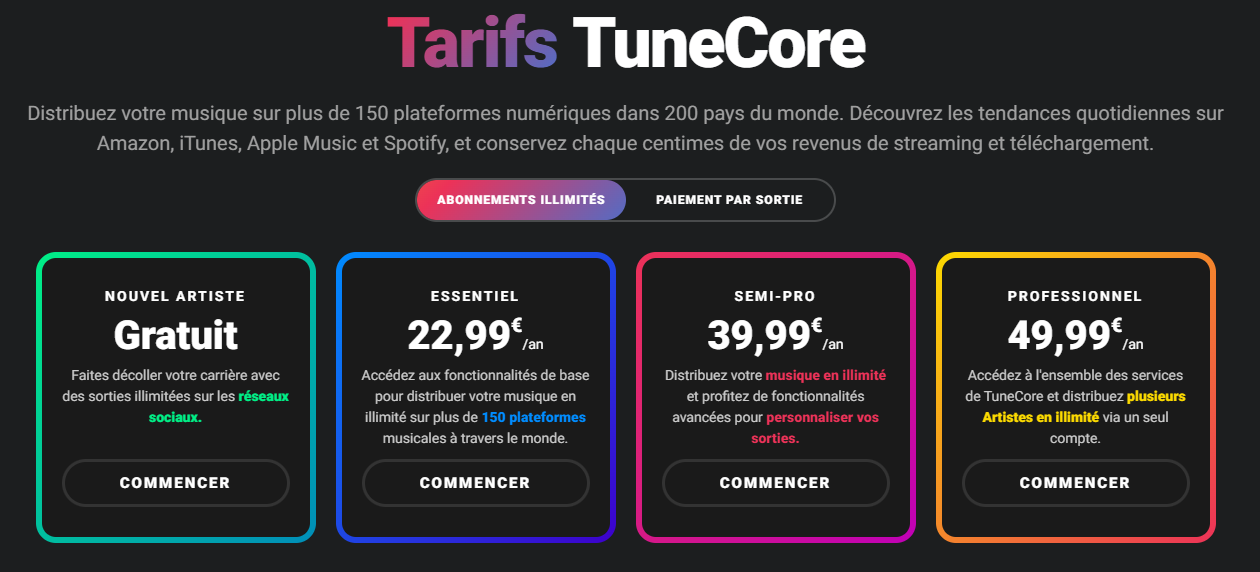
…and the new ones who will finish convincing you!
So, when you look at the price of an unlimited semi-pro subscription compared to a payment per release, there’s no comparison. I also wondered where the scam was, but in fact it seems that given the competition in the distribution sector, TuneCore has adapted its offer to remain competitive, whereas previously its model was more than profitable… I’m not surprised! If you release 10 albums with a payment per release, your next annual bill will be €539.00! With unlimited, well… Technically there is no renewal and you stay on the stores as long as you continue to pay for your subscription, so if you took the €39.99 subscription in semi-pro, well your next annual bill will be €39.99 unless you had fun taking paid options galore! Because yes, you can do that too. Come on, let’s dive into the wonderful world of TuneCore:
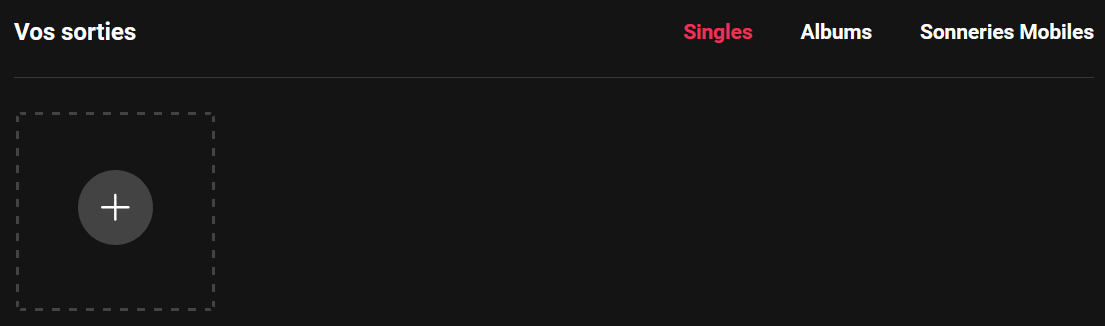
Create your first release with a counter-intuitive UX!
Well, the first time you get to grips with TuneCore is not easy… You go around in circles a bit before finding what you’re looking for given how it’s not at all designed for people who are new to music distribution! You search, you fumble around and when you’ve found it you’re happy and you try to remember how to access the interface where you are because it’s so un-ergonomic and designed for the end user. No really, the first contact with TuneCore is not easy but after a while it finally sinks in… So at one point, in the release menu, you are offered to release a single (a single track) or to release an album. The trap is to believe that a single can contain more than one track as is generally the case in almost all releases in the music industry (there is at least one B-side or an instrumental or alternative version or even a rare song or a remix… In short, it’s rarely just one track). In fact, to release a 3-track album (whether it’s a single or an EP, the difference being based on a question of total time) you have to make an album and then it’s the platforms that classify them as Single or EP depending on the total duration and some parameters specific to the broadcasting platform. When I said that it’s counter-intuitive!
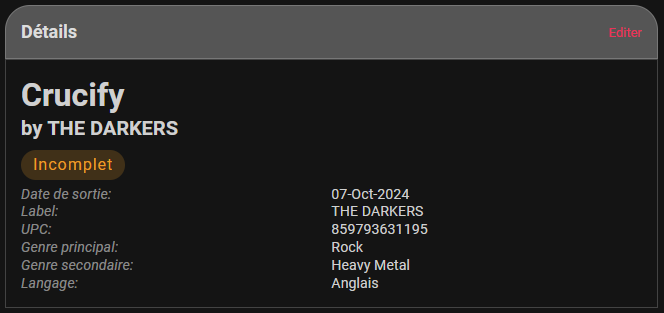
The “private joke”: releasing CRUCIFY as an EP. You had to dare!
I’ll spare you the forms that you have to fill out in advance to declare who you are, the title of the album, its author, its release date, its main genre, its secondary genre and its language. Add to that the thing that made me screw myself for my first release! Let me explain: basically, TuneCore tells you “uh buddy, you’re nice but if you want your stuff to be distributed on the platforms you’d better plan releases at least 15 days in advance to be sure that it will be available that day”… And so at the beginning, you’re not very reassured and above all you still have a lot of documentation and information to read to understand how it all works. So you say to yourself “Ok, four weeks will do” and then you say to yourself “well, come on, I’m going to prepare my other EPs for automatic distribution before distributing the album” and then it’s a disaster! Indeed, during your first release TuneCore will create your profile on Spotify and Apple and almost everywhere… Then, if you want to release another EP, they ask you to reuse your account… Except that if on your second release you tell them “yeah no actually I don’t have an account” they will try to create a second one for you and that’s when the hassle begins. So, I didn’t make a second account but for my next release I have to wait for the release of my first EP and the creation of my account, which is 4 weeks! It’s better to know this before… Otherwise you do like me: you wait.
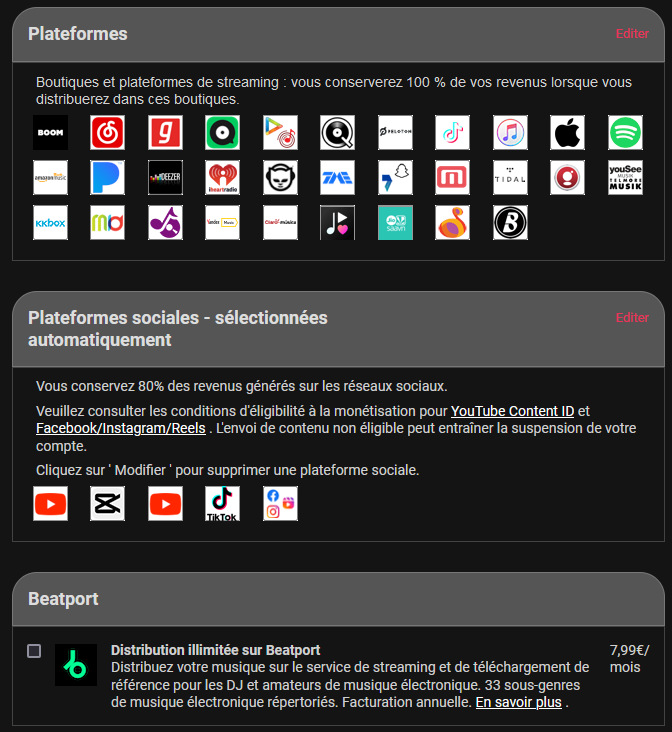
The impressive list of platforms accessible for distribution!
If I wanted to nitpick, I would say that by counting I can’t even get to 40 platforms displayed and that out of the 150 promised there are a few missing… That said, there are quite a few relays that use the main platforms so there is a chance that it will go on the other platforms anyway… There are the classic platforms (iTunes, Spotify, Napster, Boom and a whole bunch of others) and the social platforms that are also taken into account in the subscription. This means that access and distribution on these networks is included in the subscription so there is no extra charge! Fantastic! Then, there is the “Beatport” option which is paid at €7.99 / month but it is mainly aimed at DJs and electronic music fans. Ok, I admit, my current desire is to make a “Say it with Hardcore” album on the same model as “Say it with flowers” but with songs in the style of Hardcore, Speedcore, Gabber with a bit of Dark as I like. That said, the day I do that and I want to offer horrible things to DJs it will be an additional option but it is not yet current.
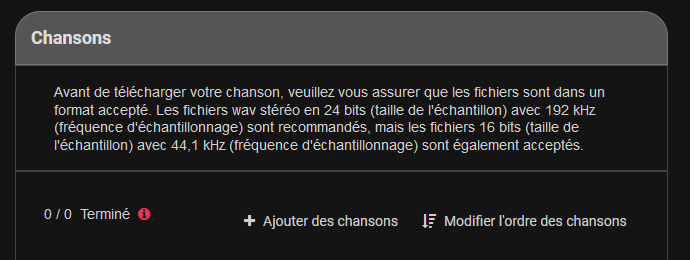
You keep your disgusting MP3 compressed with the ass, I want WAV!!!
We will have to learn that the standard in the music industry is not MP3 (except in final distribution to end customers) but rather the *.WAV format and it is better because there is no loss. The problem with the Waveform Audio File Format is that it consumes quite a lot of disk space (obviously, it is not compressed) and therefore uploading an album can take a long time. To give you an idea, in WAV 44Khz 16 Bits Stereo we have about 1 minute = 10 Megabytes. Obviously, 10 minutes is 100 MB and therefore 60 minutes is 600 MB. Uploading 600 MB is slower than downloading them because the upload speed is always lower than the download speed (ADSL principle) except in SDSL where the two are identical… We won’t talk about VDSL or doing the dishes especially since more and more of us now have fiber… musical or not, that is the question! The other question is “but, SUNO… Does it output WAVs or do you have to reconvert MP3s compressed to disgusting levels? Well, I suggest you check:
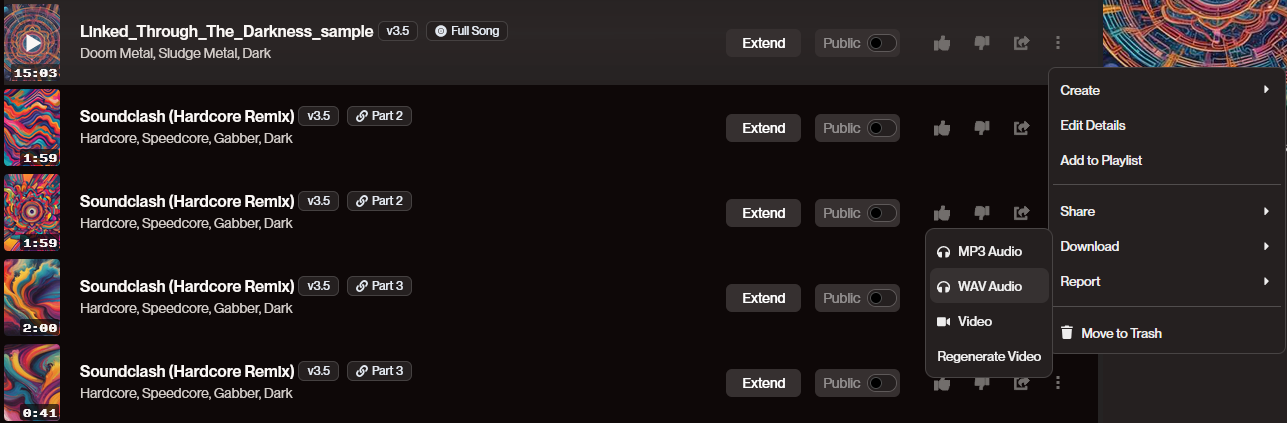
Hooray! On SUNO you can… but only in PRO or PREMIER version.
They are not stupid at SUNO: they know very well that distributors as well as companies that press CDs, DVDs or Vinyls will ask you for music in WAV format and that their compression in MP3 if we reconvert it to MP3 we lose so much that it will make it disgusting ++. So you might as well take a PRO or even PREMIER subscription (for those much more productive than me) to benefit from the option allowing you to natively download WAVs to be able to use them legally on TuneCore. In any case, downloading your creations made in FREE mode with an MP3 and reconverting it with Audacity already makes it disgusting but in addition it is prohibited by the conditions of SUNO since well it is not from a PRO or PREMIER subscription and therefore no commercial exploitation is possible. So, with my PRO subscription I am quite lucky because I can legally output my WAV… The question is “OK, but what is the output format of the WAV from SUNO? Does it meet the TuneCore requirements or will I have to tweak it on Audacity?” Good question, right? I offer you an answer in pictures:
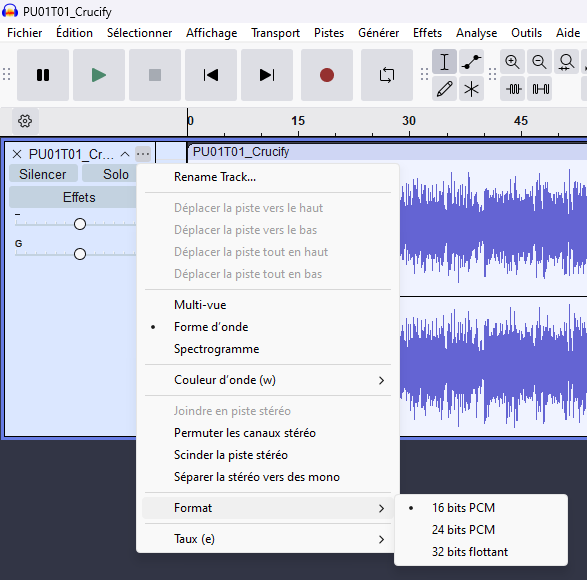
I’m missing a few bits to get to 24 but at 16 it’s fine!
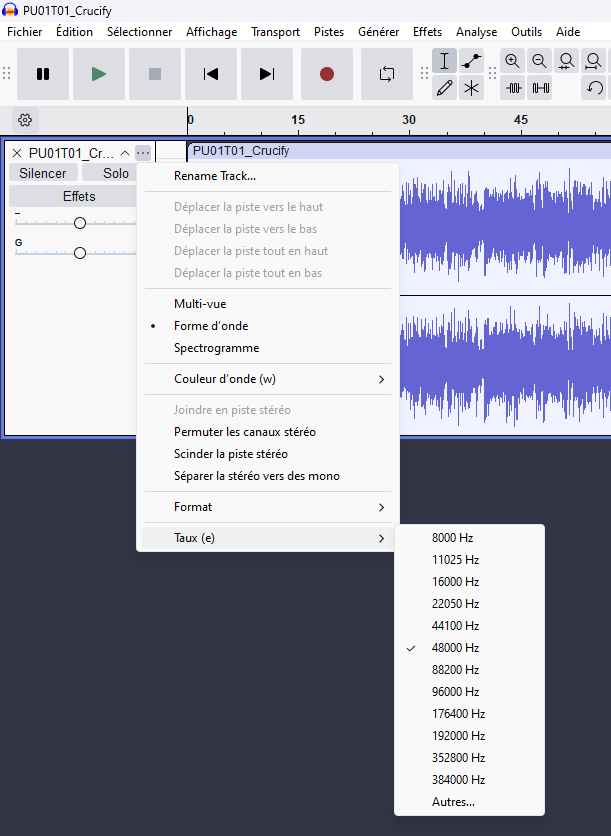
So I have a little more than 44K, shall I show it to you?
To summarize, I have 16 bits instead of 24 but it works even if it is less complete… Concerning the 44.1 Khz, we are at 48 Khz but it is not annoying. We are in stereo and I could do the conversion right away to go from one format to another but it is of no interest. Obviously, to increase the quality it would be necessary for the generation at the source to be more important because I would have the samples in 24 bits natively instead of having them only in 16. What does that change? Well, let’s put it like that. Let’s imagine that I am in a large retail sector and that I collect 16 strawberries from my market gardener but that my distribution point asks me for packaging in a punnet of 24 strawberries: if I am only given 16 in a box of 16, even if I change the box to put a box of 24 around it, I will still only have 16 strawberries to sell, whereas if my market gardener provides me with 24 natively, well, no problem with my distribution point. Now I will ask you to do a substitution operation in the previous sentence: replace market gardener with SUNO and distribution point with TuneCore (and also strawberries with bits) and you will understand what the problem is that I encounter if I convert my WAV to 24 bits when it is natively in 16 bits. That said, we don’t give a damn because like that I tested it and it works! No debate, so…
The format of our songs being sufficient for TuneCore, we will be able to concentrate on the other aspects of preparing an “album” for its upcoming distribution. Besides the fact that we will spend ages uploading our files, there is still some information to fill in… And there, believe me, there is plenty to do. I’m just taking this opportunity to make a stupid remark but if on some tracks you have crappy endings with an ending noise or garbage, in WAV and with Audacity you can remove the disgusting endings or even do a fade-out for a track that refuses to close… Yes, it’s practical… You could even (but I only recommend this to people who have a musical ear, the real one) allow you to adjust the sound of your generations a little better or even balance it or even why not do your own mastering before sending your compositions in “Raw” mode to TuneCore for distribution. Especially in the case of an album, it is always good to balance all the tracks or to have a final mix layer that will give your tracks their patina. Afterwards, you are not obliged to and even I almost never do it… SUNO still releases tracks that are relatively well balanced between them even if they are not necessarily very strong in terms of sound. A small amplification of 2 or 3 db can change the perception of a song but to be used with caution and especially to listen with headphones to really understand what is happening. Here, let’s move on to our song form:
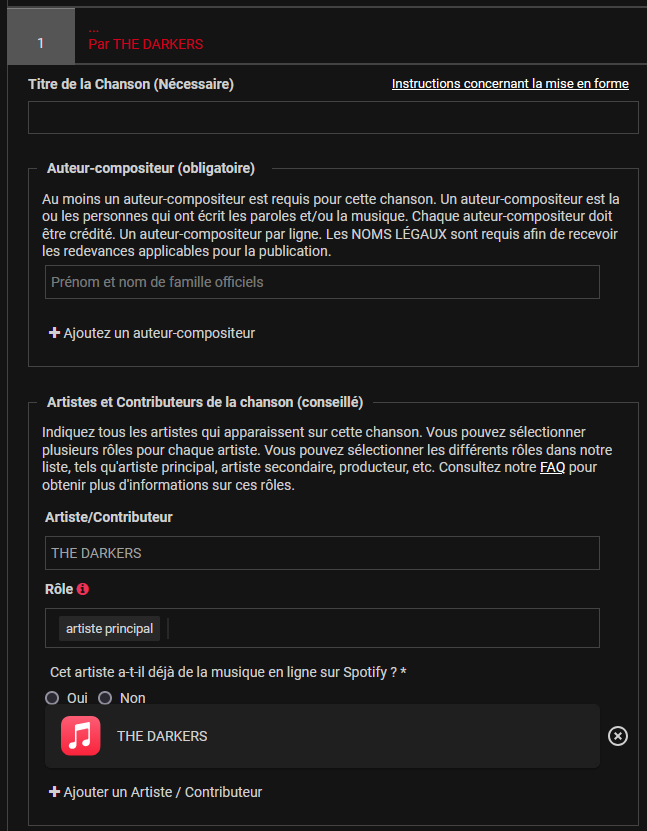
Usually, the trouble starts here.
We start by entering the title of our song (this is mandatory more than necessary) while respecting the instructions concerning the formatting (this is VERY important) then we declare ourselves with our main identity (unless there is another author/composer but this is not the case) and we declare the artists and contributors of the song. So we tell you that it is recommended: yes, you can not do it but in the event of a dispute if you have not done it well it sucks. I do it systematically, it costs less time than writing this sentence in its entirety! Finally, I come back to the fact that I ultimately screwed myself for my first publication since if I declare that I am not on Spotify they will try to create a new account for me each time while I would like to keep my one and only account that they will create for me later… Suffice to say that it will delay the second release quite a bit but it is a relatively minor inconvenience. Let’s see the rest of the form:
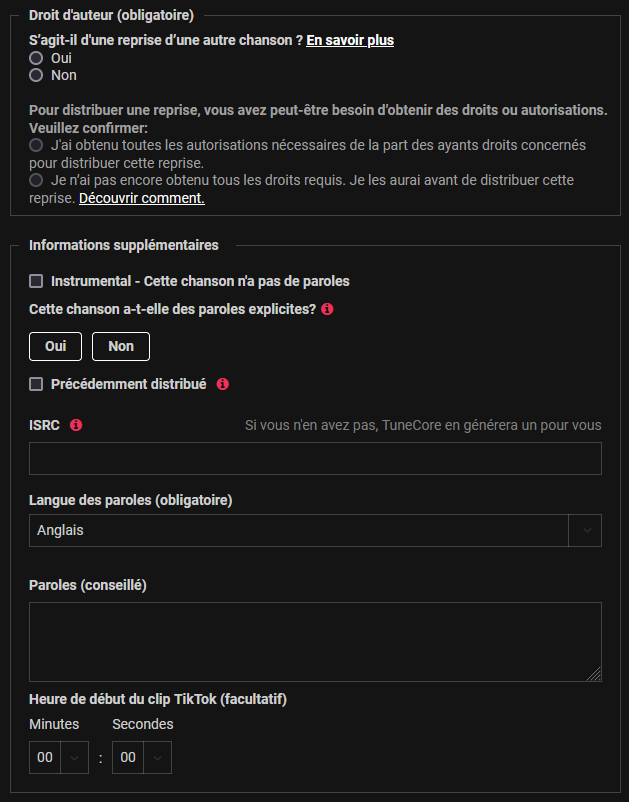
…and end there, because it’s not that simple!
Let’s start with copyright. As long as you don’t do covers, everything is fine! If you do a cover and decide to publish it, you will have to ask the rights holders concerned if they grant their permission because of course, you can’t do just anything. The good news is that by going through SUNO, you have accepted the idea that you cannot do a cover or remake of an existing song for which you do not have the rights. You could do it but in this case you need permission and in practice artists are not very inclined to give their permission to run their song through the AI for analysis purposes to make a remix or a cover… So don’t mess with it for the moment! Regarding additional information, the notion of explicit lyrics is anything that contains references to violence or drug use, swearing and all sexually graphic or suggestive lyrics. I might as well tell you that when I release “PornBlast” some people are going to be scratching their heads… It’s got all that in it: parental advisory +++ for this song. And then TuneCore can choose to censor it at its discretion. We’ll see how many of my songs survive the censorship!
“Previously distributed” is when, for example, I release an album after my singles (or EP) and I have to reference my songs from the album in it. I might as well tell you that you’re going to have to be square and write down the release dates somewhere, otherwise it’s going to quickly become problematic. I’ll come back to the ISRC last; before that, I’ll specify that the language of the lyrics is mandatory and that I feel like I’m going to get bored with “Japanese Inspiration” for which the lyrics are in Japanese or “Ranenbourg” or even “Chanson pour un crâne mou” in French. It’s going to be messy, especially if the lyrics have to be included. Here too, we are told that it is recommended, but I consider that it is more than recommended in the event of a dispute. The time of the TikTok clip is the time of the song. Then, all that remains is to register the song, specifying whether it is the last one or not, and so on. I will quickly return to the history of ISRCs. An ISRC is a unique identification number for your phonograms or music videos that you can obtain for free by registering on the SCPP (Société Civile des Producteurs Phonographiques) website. There is no need to pay anything, but nothing prevents you from joining the SCPP if you also want to collect royalties as a producer (it will cost you €150).
Go get yourself registered, phonogram of my two (ears)!
So whether it is about registering songs or recovering missing rights, you can do the same thing with TuneCore as with SCPP. TuneCore offers by default to register your phonograms knowing that they have the certification authority that was issued to them for that… But they will distribute ISRCs of the type TC-AIS-24-XXXXX which are specific to them while SCPP will rather distribute ISRCs of the type FR-9W1-24-XXXXX which is a little more explicit on the country of origin. Then, they offer their TuneCore Publishing service at €79 each and it is almost half as much as SCPP… Except that SCPP is French and TuneCore is American. Now, even if we go to conquer the States, before getting there we must already consider that we will be distributed locally and that the protection of rights by the United States in Europe well… It is better not to count on it too much. In short, TuneCore includes the possibility of doing the registration yourself and that is already very interesting. Let’s see what happens next:
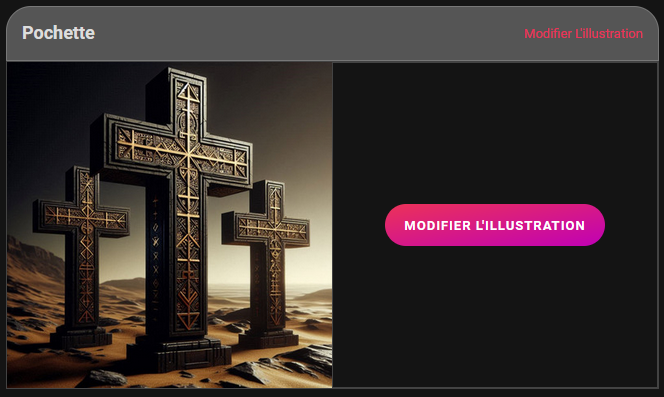
All that was missing was a cover to complete the work in question!
Come on, I’m going to let you in on an open secret: I generate my album and EP covers on Copilot which uses Dall-E. It turns out that the companion provided by Microsoft is quite good at understanding my way of writing a prompt and that it is able to give me exactly what I expect from it 9 times out of 10 with a rather convincing result. The cool thing is that it systematically generates square images of 1024 pixels * 1024 pixels. Except that at this level, TuneCore is a bit greedy and it requires 3000 pixels * 3000 pixels and that’s going to hurt a bit in the ass! Indeed, natively my generator does 1024 x 1024 so how do I switch to 3000 x 3000? Simple, with Microsoft’s most basic thing, that is to say the Photos application which allows you to resize images, as illustrated below:
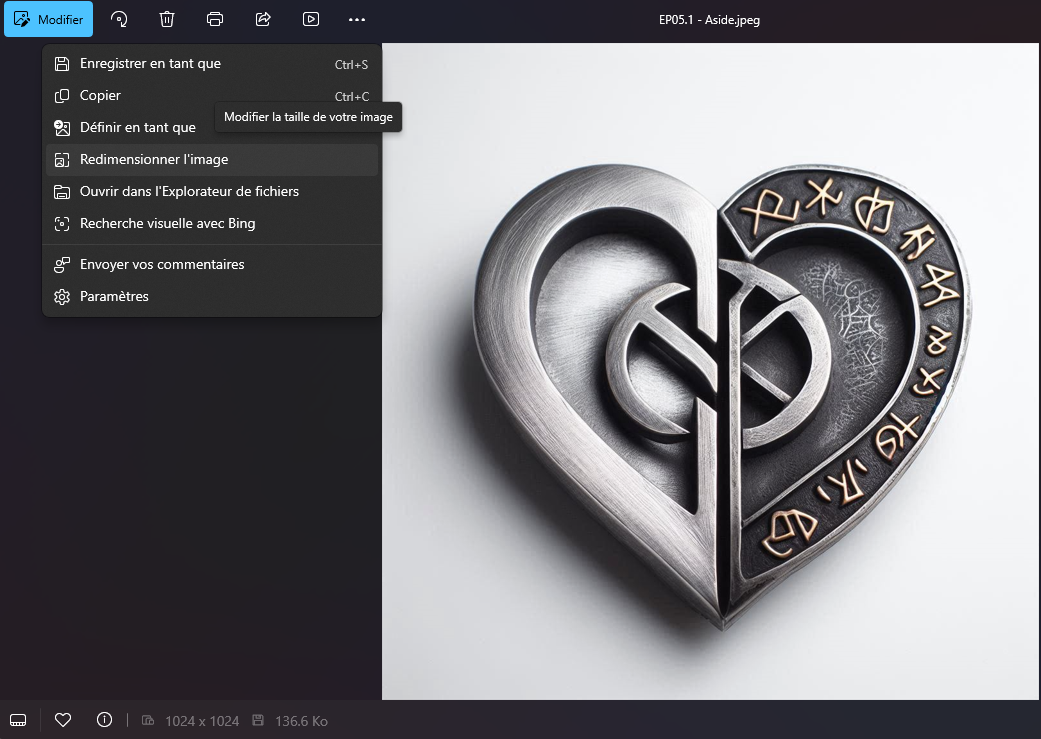
Cheap and effective resizing!
I rework my image a little so that it seems bigger than reality… A bit like what all men do when talking about their… In short, it’s all a fuss over nothing really. Once the album or singles cover is loaded, I have one last operation to do:
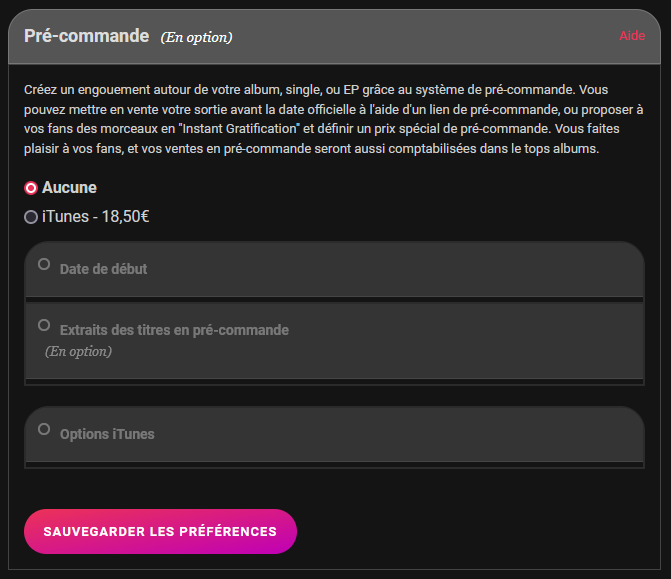
Hype is not really cheap when you have to buy it…
So as for the pre-order, when you’re starting out and you’re not at all established, when no one knows you, knows what you do and no one follows you, well… It’s totally futile as well as useless. Now, if I were on my third album with ultra-positive comments and a presence among music professionals, well then I could consider the question but since there are strong reasons to think that this will never be the case, well… The “pre-order” option on iTunes is not the one I’m going to favor for my releases. I remind you that I’m not going to do a concert, not live and that concretely I make music assisted by AI. It’s already a slightly risky project, we’re not going to throw money out the window for ego issues that I don’t have, are we?
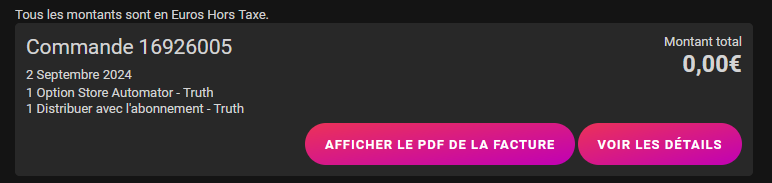
Each album or EP produced is the subject of an order… ehhh yes, it’s business!
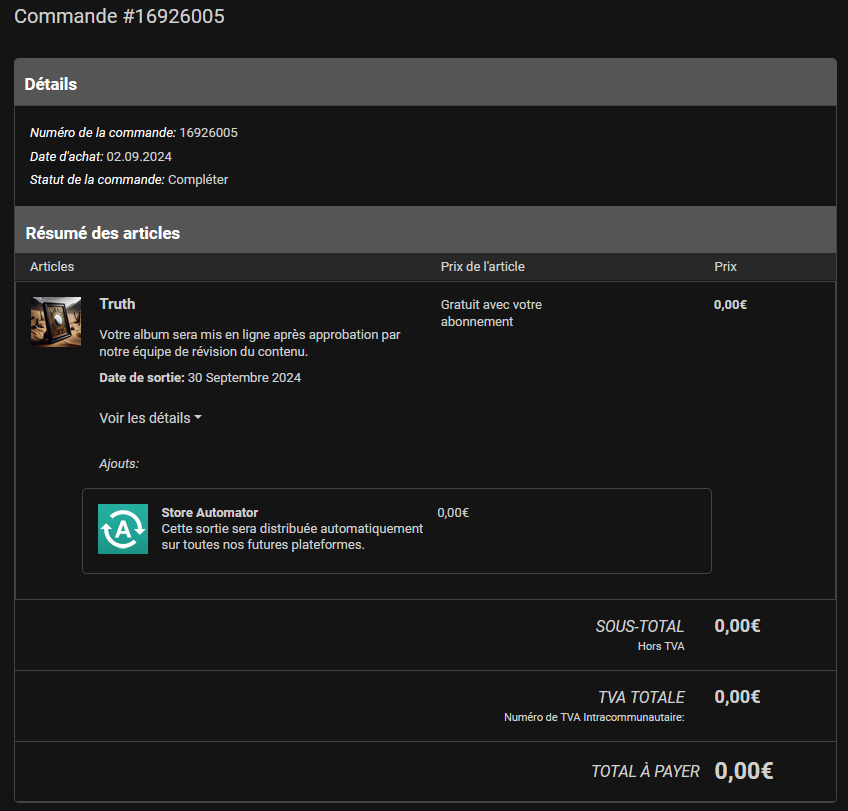
Here is the breakdown of what this outing cost me with my subscription: €0.00
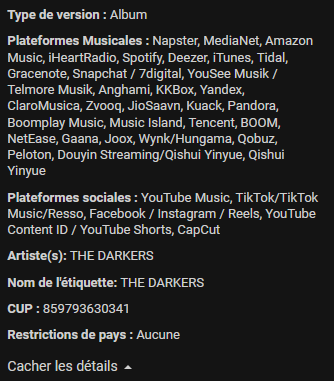
And here are the platforms I will be distributed on, IF…
Well, we are coming to the end of this article and its rather interesting conclusion. Indeed, you have seen that it does not really happen by itself and that at each stage of the process there are many things to do… And yet, we do not have to bother filling in the MP3 tags although it must probably be done with the dozens of pieces of information that we must enter for each track! In any case, one might think that at this point we are done? Nothing! This is only the beginning of the journey and there are still steps to take before our EP is distributed on the stores… And believe me, even if it is simple I must remind you that we are on the edge each time with our story of Artificial Intelligence as an aid to composition!
Indeed, it’s not as if we just released an album with our own music group, our sound and our identity… A group like Indochine releases an album, we almost immediately recognize the identity of their characteristic sound that passes from album to album. It’s a sequence of chords, a rhythm, a sound that we don’t find in all the songs but at least somewhere on the album it’s there: an imprint of the soul of the group. I arrive with music that has no soul according to most musicians. So no matter what dynamics I’m going to push or add as content in it, it will always be systematically crap for my contemporaries. The problem is that before being distributed on the stores, I’m going to have to go through the judgment of my contemporaries…
Admit that it leaves you speechless!
